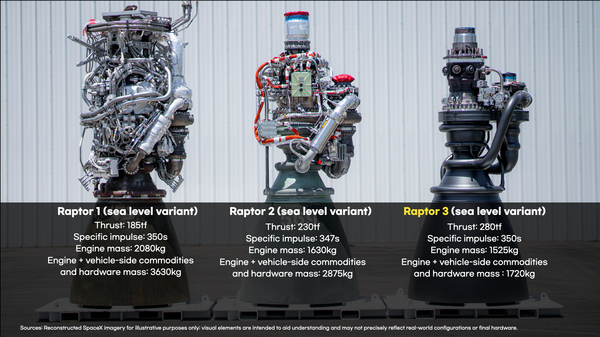
Why SpaceX Designed Raptor 3 as Fleet Hardware
SpaceX’s Raptor 3 signals a pivot from bespoke aerospace engineering to high-throughput industrial logistics. This analysis explores the economic logic, risk tradeoffs, and manufacturing discipline defining Starship’s fleet hardware.

In Part 1, we examined why Raptor 3 looks “alien.” We also examined how methane and Mars reshaped its design.
Part 2: The Engine as an Industrial System
In 2024, when Elon Musk described Raptor 3 as “alien technology,” the phrase landed as spectacle. But the more revealing shift is not aesthetic. It is industrial.
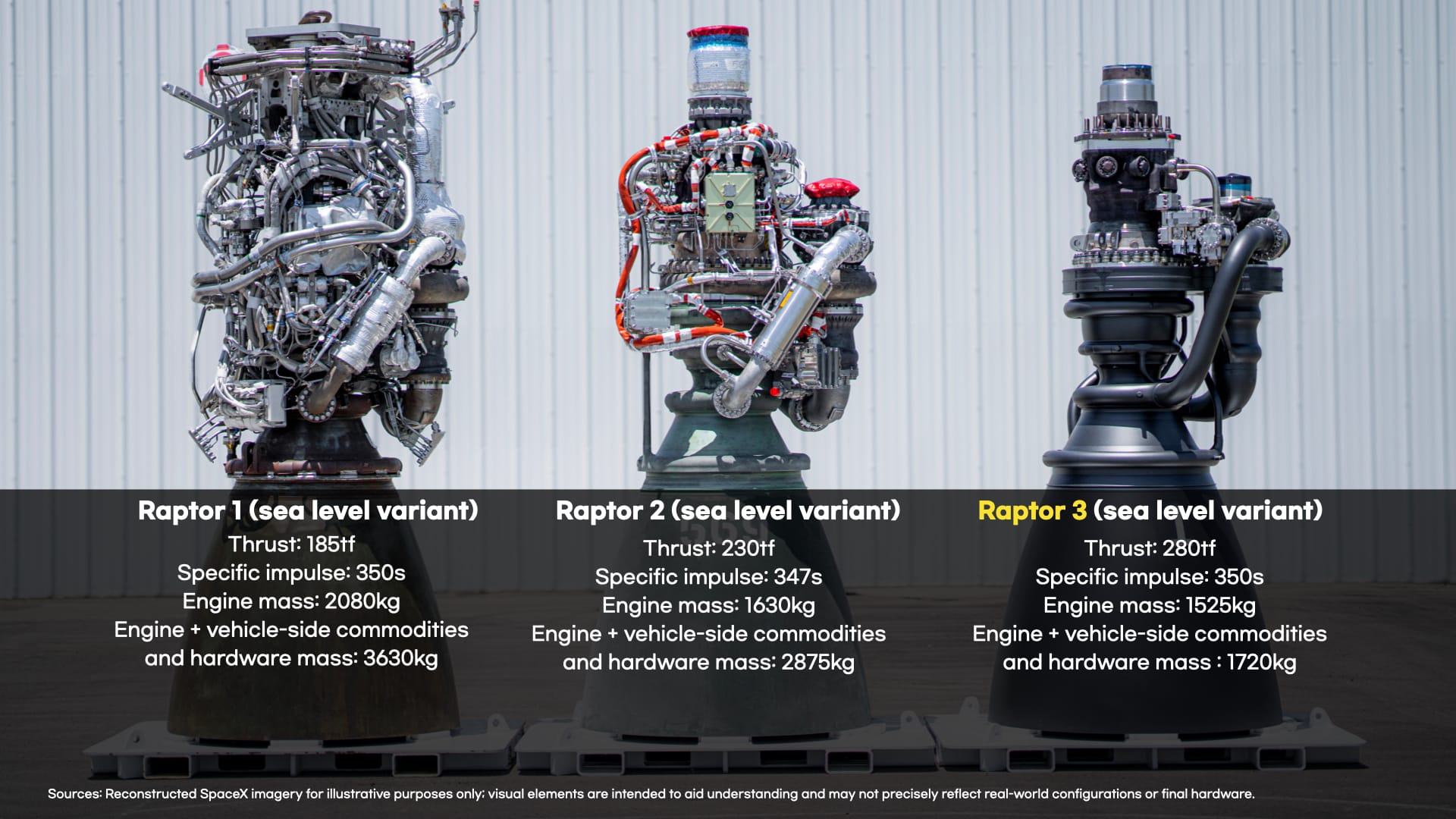
Raptor 3 does not merely represent a new rocket engine. It reflects a different economic assumption about the future of spaceflight. Traditional systems were designed for missions measured in minutes and hardware produced in small batches—a model closer to aerospace craftsmanship than high-throughput manufacturing.
Raptor 3 is designed as fleet hardware.
The Factory Constraint
Starship architecture implies dozens of engines per vehicle and, ultimately, fleets of vehicles. This reality forces a shift from performance-first to production-first design.
The smooth exterior of Raptor 3 is the visible artifact of this consolidation. By internalizing complexity—fuel lines, sensor harnesses, and flanges—SpaceX seeks to minimize interfaces. Interfaces—seals, joints, and connection points—have historically been common sources of leakage and failure in aerospace. Raptor’s industrial logic suggests that reducing the number of these interfaces directly reduces potential leak paths and machining operations, thereby increasing manufacturing throughput.
Reliability Through Deletion: A Risk Tradeoff
Musk argues that Raptor 3 is designed to eliminate the need for a traditional, basic heat shield. According to Musk, an open architecture allows minor fuel leaks to dissipate into the existing flaming plasma rather than accumulating in a contained engine bay.
This strategy represents a fundamental tradeoff: shifting risk from enclosed accumulation (which can lead to catastrophic contained fires) to exposure management. While counterintuitive, the goal is to reduce systemic risk by removing the protective structures that can mask or compound failures.
FFSC as a Manufacturing Discipline
The Full-Flow Staged Combustion (FFSC) cycle is a manufacturing challenge as much as a performance achievement. By ensuring no propellant is dumped overboard as turbine exhaust, SpaceX reaches efficiency levels Musk describes as unprecedented in operational hardware.
Raptor’s viability depends on advances in materials science, cooling channel design, turbomachinery precision, and manufacturing repeatability at scale. Historically, oxygen-rich environments were avoided because high-pressure oxygen aggressively attacks most metals. Raptor’s viability rests on engineering capable of surviving these internal environments while maintaining the cadence of mass production.
Mars: The Logistics Requirement
The choice of methane is driven by the requirement for In-Situ Resource Utilization (ISRU). Methane offers dramatically reduced soot and coking compared to kerosene, which is essential for the rapid turnaround of a reusable fleet.
The long-term vision relies on the Sabatier reaction: combining Martian CO2 with hydrogen (H2) to produce methane (CH4) and water (H2O). Hydrogen is typically sourced by electrolyzing subsurface water ice, with system designs aiming to recycle H2 to improve overall efficiency, turning the propulsion system into a node within a planetary logistics network.
From Expedition to Fleet Hardware
The Apollo-era F-1 engine was a masterpiece of bespoke engineering. Raptor 3 is the pivot toward industrial logistics. It optimizes for:
☑️ Production yield and repeatability
☑️ Cost per unit
☑️ Turnaround interval between flights
☑️ Replacement speed
This shift reflects a different economic assumption: spaceflight is no longer a singular, heroic achievement, but a matter of sustained throughput.
This article reflects independent industrial analysis and does not constitute investment advice.