China Didn't Copy Gigacasting. It Rearranged It.
The casting hung on a side wall. The front wall had a body painted in five colours and a materials legend. China isn't copying gigacasting. It moved the argument to the alloy.

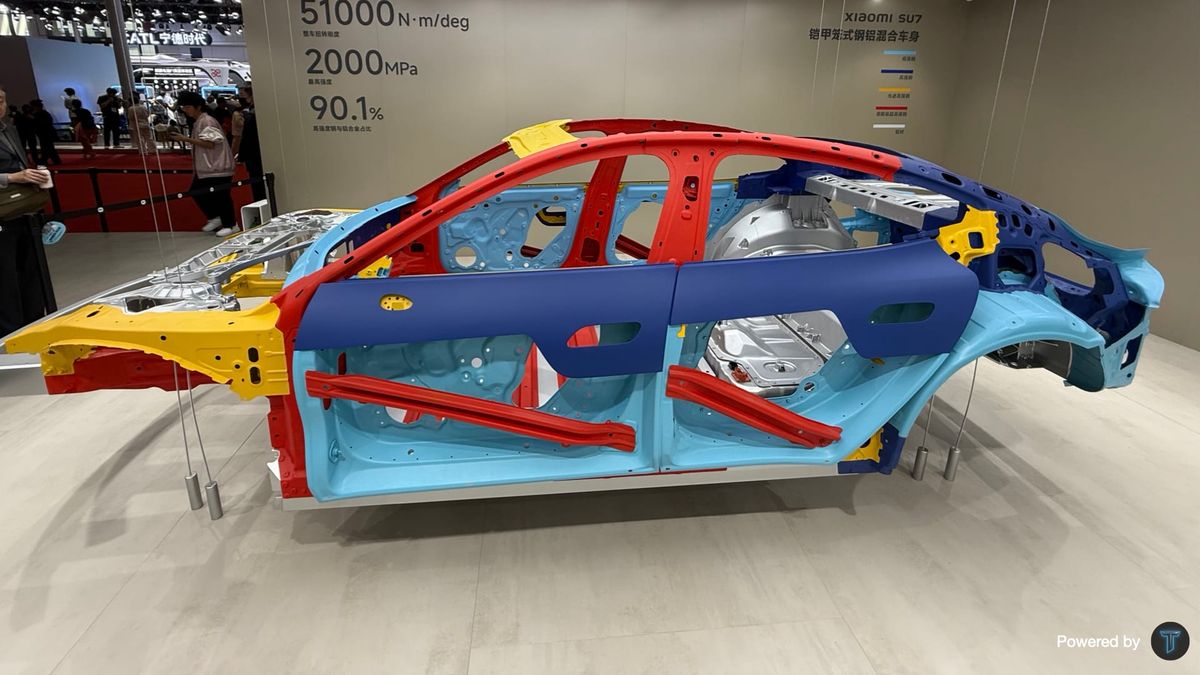
The largest casting was not the thing that stood out on the Chinese stands. The casting hung on a side wall. What occupied the front wall was a body-in-white painted in five colours and a materials legend to read it by. That arrangement is the catch-up strategy in miniature. Instead of boasting about the machine, they were boasting about how the materials were allocated.
The headline was not the press
The front wall of the Xiaomi SU7 display was titled with the phrase for an armoured cage-type steel-aluminium hybrid body. Beneath it, the colour legend ran to five tiers: low-strength steel, high-strength steel, advanced high-strength steel, submarine-grade ultra-high-strength steel, and aluminium.
The body on display was that legend rendered in metal. The red ultra-high-strength steel ran through the A-pillars, the roof rails, and the door impact beams. The yellow advanced high-strength steel traced the front side members. The silver aluminium casting sat around the rear wheelhouses.
Three numbers were on the wall: 51,000 N·m/deg of torsional rigidity for the whole vehicle, a maximum strength of 2,000 MPa, and a 90.1% share for high-strength steel and aluminium alloy. All three match the figures Xiaomi has published since the SU7 was unveiled at the end of 2023.
What the remaining 9.9% consists of is not on the wall. The premise here is that 90.1% describes a share of the body structure, but nothing states whether that share is measured by mass, by area, or by part count. A ratio without a stated basis cannot be checked.
The alloy is being treated as a product
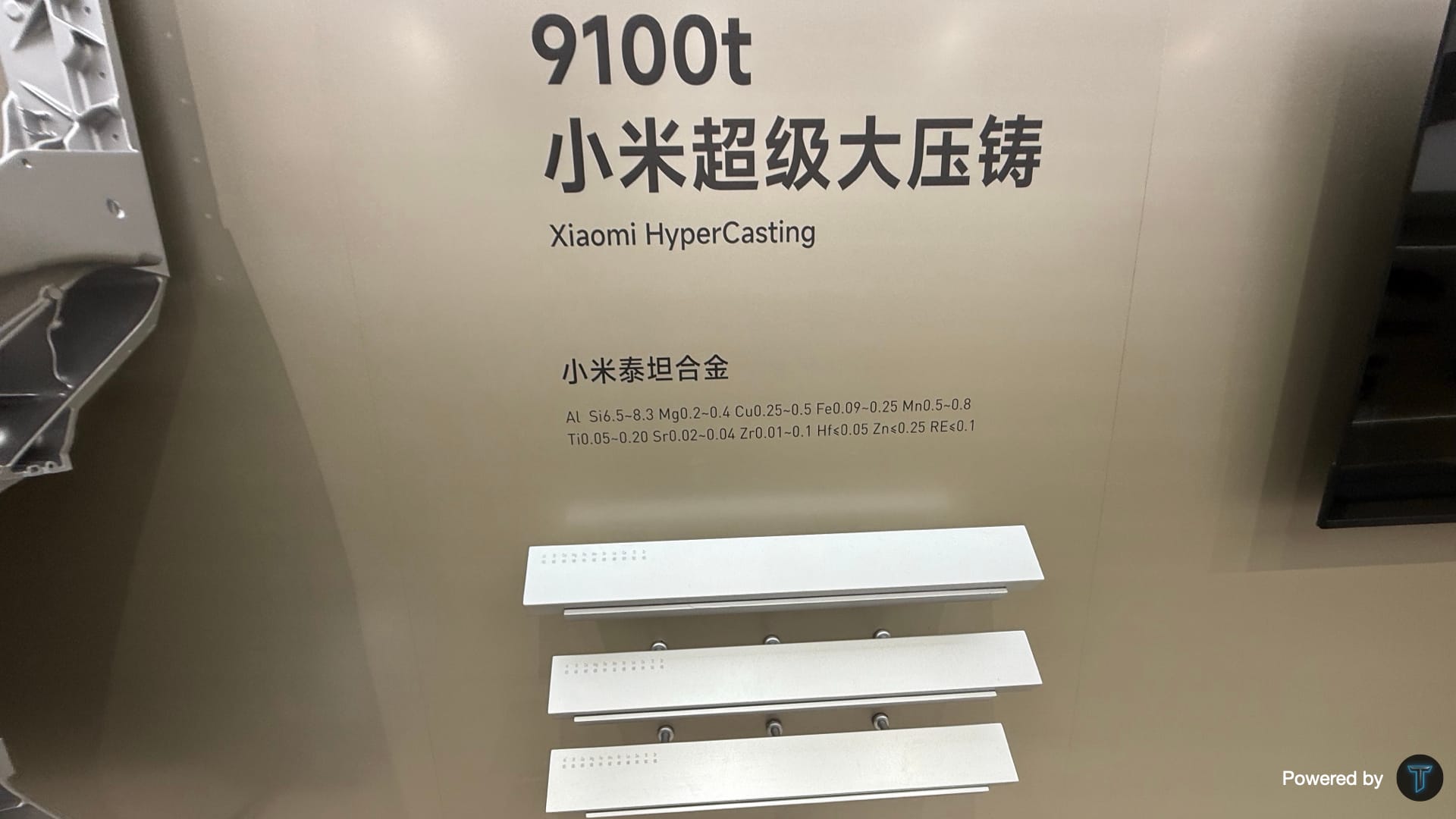
The side wall holding the casting was titled 9100t HyperCasting. Below it, the composition of Xiaomi's own alloy, Titans Metal, was printed out in element symbols and content ranges.
An aluminium base carries silicon at 6.5 to 8.3, magnesium at 0.2 to 0.4, copper at 0.25 to 0.5, iron at 0.09 to 0.25, and manganese at 0.5 to 0.8. Titanium at 0.05 to 0.20, strontium at 0.02 to 0.04, and zirconium at 0.01 to 0.1 are added in trace amounts, while hafnium, zinc, and rare earths appear with upper bounds only.
That composition did not arrive by chance. Xiaomi has said it worked with China's national key materials laboratory to evaluate more than 10.16 million formulations through AI simulation before selecting this one. The casting machine was co-developed with Haitian Die Casting, and the full cluster comprises 60 pieces of equipment and 433 process parameters.
What follows is more telling. In May 2026, Xiaomi Titans Metal was registered with EPD International as an environmental product declaration. The registration describes the alloy as manufactured from post-consumer recycled aluminium, supplied in rectangular ingot form, and used for shock absorber towers, rear longitudinal beams, ultra-large integrated die-cast floor panels, and integrated die-cast front cabins.
Ingot form and a third-party verified environmental declaration are not the grammar of a captive component material. They are the grammar of a material product that can be sold on its own. Publishing the composition on a trade show wall reads the same way. Tesla does not disclose the composition of its own casting alloy. One company treats its alloy as a trade secret. The other treats it as a catalogue item.
The casting on display was a rear underbody. Seen from the side, its interior was filled with a triangular lattice of ribs, the structure you use to hold stiffness at thin wall sections.
What it means that the name is different
The title said HyperCasting, not gigacasting. Thatcham Research, the UK automotive risk intelligence centre, uses the neutral term "mega cast" for the component in its reporting and notes that "giga cast" and "hyper cast" are terms branded by individual manufacturers.
So the name Tesla coined did not become the standard term, and the follower attached its own instead. Adopt a technology and keep its name, and the origin stays stamped on it. Changing the name is the cheapest available way to erase the fact of adoption.
What gets made and what gets bought
The high-performance display area showed a different principle at work. The tyres on the 21-inch wheels were Pirelli P Zero 5, 265/35 R21 at the front and 305/30 R21 at the rear. The brake calipers were Akebono, six-piston front and four-piston rear. The carbon ceramic discs were marked for a maximum operating temperature above 1,300°C.
The same area held a 1.7 m² carbon fibre roof, a carbon fibre rear spoiler, and carbon fibre side skirts. The dual-chamber closed air springs adjust stiffness and ride height independently across a 30% stiffness range, and the variable dampers were listed at an adjustment frequency of 1,000 times per second.
Put plainly: the press and the alloy are developed in house, while the tyres and brake calipers are bought from Italy and Japan. There is a consistency to that. What compounds gets brought inside. What can simply be purchased stays outside. Alloy formulation and casting parameters accumulate data as volume grows. A brake caliper does not.
The real axis was never the car
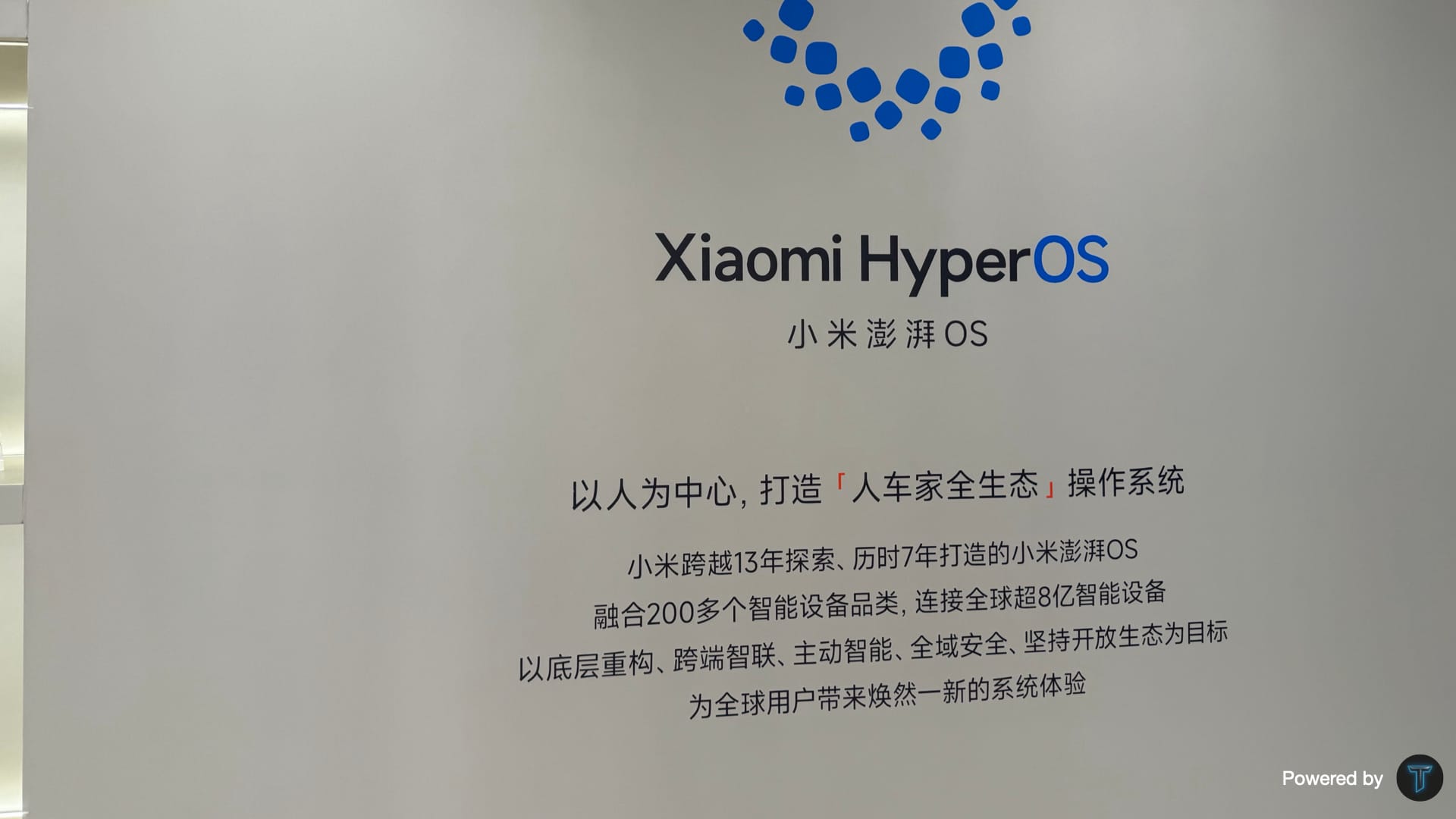
Another wall on the same stand carried an operating system rather than a car. The Xiaomi HyperOS panel described a human-centred operating system spanning people, vehicles, and the home. It ran on to say the system came out of thirteen years of exploration and seven years of development, that it unifies more than 200 categories of smart device, and that it connects over 800 million devices worldwide.
Putting an operating system wall inside a car stand is not how you sell a car. It is how you define a car as one terminal in an ecosystem. In an earlier column I wrote that the remaining differentiators had narrowed to assembly architecture and the software layered on top. This wall is a declaration that the second one is already the axis.
And on to robots
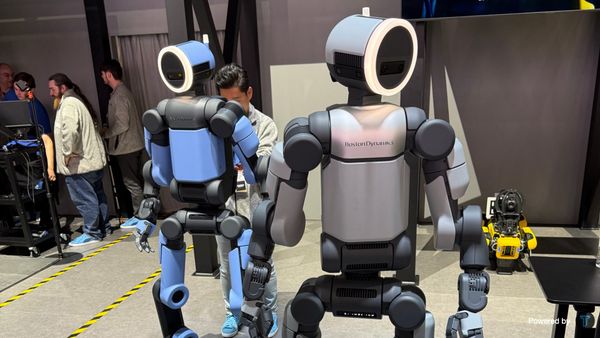
Elsewhere in the hall, XPeng displayed its humanoid robot IRON under a heading claiming the closest thing yet to a human. The listed specifications were 178 cm tall and 70 kg, with hands built at 1:1 human scale carrying 22 degrees of freedom. Active reasoning, human-like continuous conversation, and autonomous natural walking made up the rest.
Tesla set the template for an EV maker extending into humanoids. The direction differs, though. Tesla frames its end-to-end driving network as a foundation model for robotics and emphasises the shared technology stack. This wall led with human likeness rather than with the stack. Same extension, different thing being sold.
What Korean industry should read here
In an earlier column I wrote that gigacasting had shifted from a differentiator to a requirement. This stand poses the question that comes after: once you have the technology that has become a requirement, what do you differentiate on?
The Chinese answer, as displayed, came in three parts. Own the material. Own the name. Redefine the car as a terminal in an ecosystem. None of the three depends on how many tonnes of clamping force you install.
Korean automakers sit in the group that has announced megacast implementation plans. Adoption itself is a matter of time. The question is whether the headline to hang above it afterwards is being prepared now. A stand's front wall is the most honest statement a company makes about what it intends to win on.
For research inquiries or collaboration, contact: ceo@technorns.com