Why Boston Dynamics Had to Reinvent Atlas
From DARPA's disaster-response robot to autonomous industrial work, Atlas has spent more than a decade solving problems that go far beyond walking on two legs.

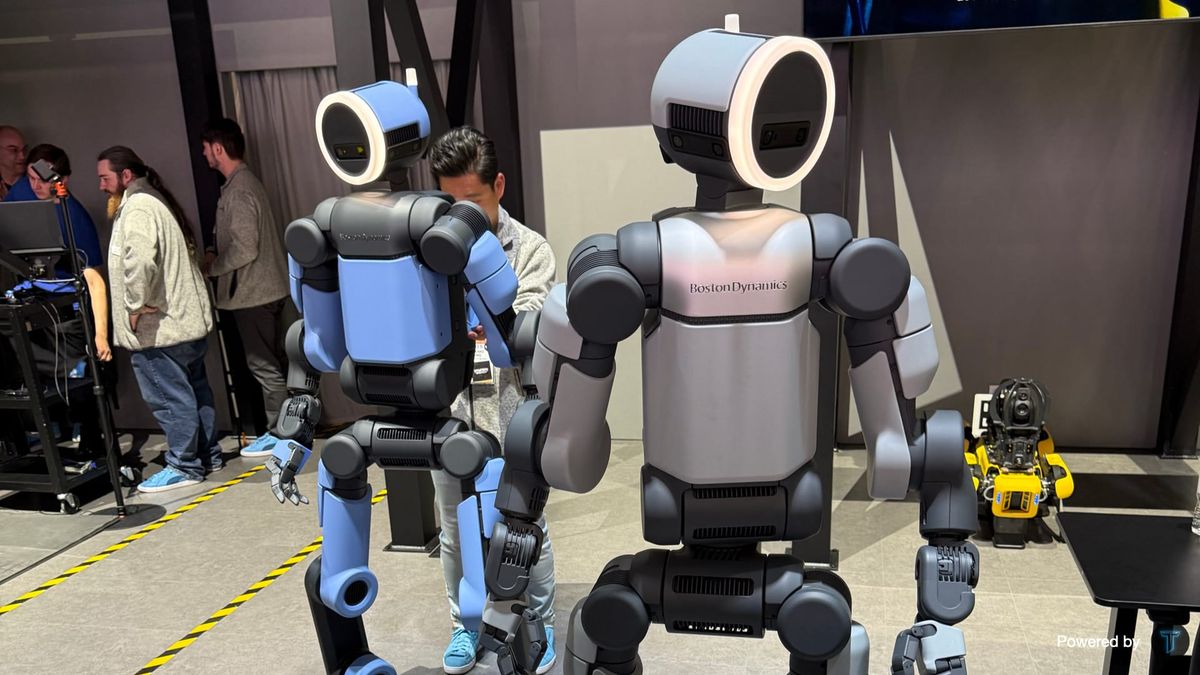
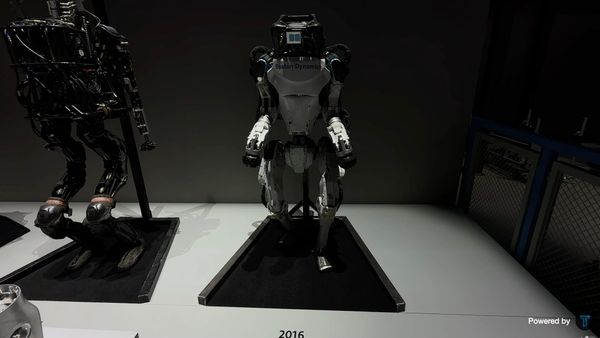
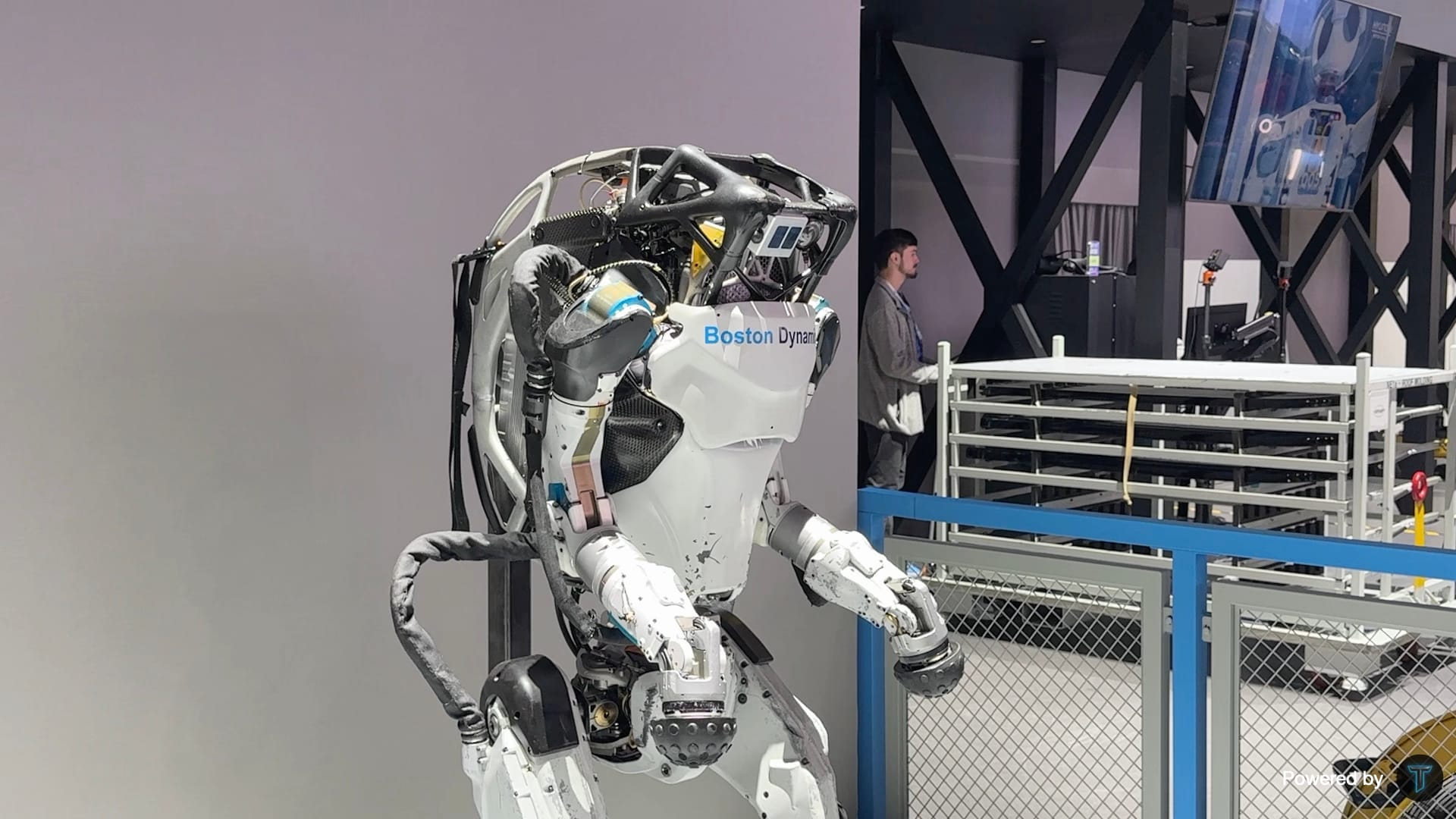
In 2013, Boston Dynamics introduced Atlas as part of the DARPA Robotics Challenge.
It stood about 188 centimeters tall, weighed roughly 150 kilograms, and had 28 hydraulically actuated joints. The early robot was connected by a tether to an external power supply and computer, while an operator issued commands through a control unit. Atlas also carried an onboard real-time control computer.
DARPA described Atlas as a physical platform on which research teams could develop and test their own control software.
The original goal had little to do with manufacturing.
Atlas was designed for research into disaster response. The challenge included moving through debris, opening doors, turning valves, and using tools designed for people.
The Fukushima nuclear accident had demonstrated why such capabilities might be needed. Some environments were simply too dangerous for people to enter.
But making a robot that could move through these environments was an enormous engineering challenge.
Why Atlas Needed to Do Backflips
Over the following decade, Atlas became much more capable.
By 2021, it could jump over obstacles, balance on narrow structures, and perform sequences of parkour movements.
In 2023, Boston Dynamics showed Atlas picking up a wooden plank, using it to create a path, and carrying a tool bag to a worker standing on a raised platform.
At the end of the demonstration, Atlas performed another acrobatic movement before landing.
When I watched these demonstrations, I had a question.
Why not just climb down?
The answer was in the control system.
When Atlas jumps and rotates its body, controlling the legs alone isn't enough. The arms, torso, and legs all change position. The robot's center of mass and angular momentum also change throughout the movement.
Boston Dynamics used Model Predictive Control, or MPC, to manage these motions.
The controller uses a mathematical model to predict how the robot's body will move over a short period. It then calculates the forces and movements needed to achieve the intended result.
Those calculations are updated continuously as the robot moves.
The challenge became even more complicated when Atlas started handling objects.
Earlier control models could simplify the robot's movement using quantities such as its overall center of mass and inertia.
For more demanding manipulation tasks, Boston Dynamics developed a model that accounted for the momentum of individual body links and the forces created by objects in the robot's hands.
Consider what happens when Atlas jumps while holding a wooden plank.
The plank has weight and momentum of its own. Its movement changes the forces acting on the robot.
The controller has to account for the plank while coordinating the rest of the body.
Throwing a tool bag introduces similar problems. The arms cannot be treated as completely separate from the torso and legs.
The movement of the entire system matters.
But this doesn't mean Atlas was inventing every movement from scratch.
In the 2021 parkour demonstrations, complex maneuvers such as vaulting were developed in advance using offline trajectory optimization.
During execution, MPC adjusted the movement to deal with differences in obstacle height, foot slipping, and errors in the robot's position.
Atlas was becoming exceptionally good at controlling its body.
That was a major engineering achievement, but it wasn't the same as having general-purpose intelligence.
What the Demonstration Videos Didn't Show
Most people know Atlas from videos in which the robot successfully completes difficult movements.
The actual development process looked different.
Boston Dynamics also published footage of Atlas falling and failing during its experiments.
Those failures were part of the research.
Engineers examined the data, adjusted the control system, and tested the movement again.
A failed attempt in a laboratory could help improve the next attempt.
A factory presents a different problem.
A robot working on a production line has to perform the same operation repeatedly, often for hours at a time.
When something goes wrong, the robot needs to detect the problem and recover without unnecessarily interrupting production.
A successful demonstration tells us that a robot can perform a task.
It doesn't necessarily tell us how reliably the robot can repeat that task over weeks or months.
This is one of the biggest differences between experimental robotics and industrial automation.
Boston Dynamics Replaced Its Own Robot
In April 2024, Boston Dynamics retired the hydraulic Atlas and introduced a fully electric version.
By then, the hydraulic robot had become one of the most agile humanoid research platforms ever demonstrated.
So why replace it?
Boston Dynamics was preparing Atlas for a different kind of work.
Hydraulic systems had allowed the earlier robot to generate substantial forces and perform fast, dynamic movements.
But the company wanted to reduce mechanical complexity, lower operating noise, and improve energy efficiency.
Electric actuation was part of that redesign.
The new robot also had a different approach to joint movement.
Although Atlas retains a recognizable humanoid shape, its joints are not restricted to the same ranges of motion as human joints.
In situations where a person would need to turn their entire body, Atlas can rotate its joints through much larger angles.
That gives the robot more options when positioning itself for a task.
Boston Dynamics had decided that a humanoid robot could benefit from the human body plan without reproducing every limitation of human anatomy.
This wasn't simply an effort to make the old Atlas move better.
The company was redesigning Atlas as a product.
Walking Was No Longer Enough
Replacing hydraulics with electric motors didn't automatically make Atlas ready for factory work.
Consider a seemingly simple task: picking up an automotive component and moving it to another container.
The robot first needs to locate the part.
It must determine the object's position and orientation, identify where to grip it, and calculate how to lift it without losing control.
Once the part is in its hands, the robot must keep track of its position.
If the object slips, the destination moves, or the part fails to fit into its assigned slot, the robot needs to recognize what happened and respond.
Boston Dynamics demonstrated some of these capabilities in its engine-cover sequencing work.
Atlas used a machine-learning vision model to identify surrounding equipment and containers.
A specialized grasping policy controlled how the robot picked up the engine covers. A tracking system continuously estimated the state of the objects being handled.
The company reported that the demonstration used no prescribed movement sequences or teleoperated motions.
Instead, the robot generated its movements autonomously during the task.
When a container was moved, Atlas could detect the change and adjust its behavior.
It could also respond to failed insertions, collisions, and other interruptions.
This was different from the parkour demonstrations.
The robot wasn't simply executing a previously designed acrobatic movement while correcting small errors.
It was using perception to decide how to perform a manipulation task in an environment that could change.
That distinction matters.
A robot that can execute a difficult movement is useful for understanding control.
A robot that can recognize a changed environment and continue its work is closer to what manufacturers need.
The Next Problem: Teaching Atlas to Work
In 2025, Boston Dynamics and Toyota Research Institute published research on Large Behavior Models, or LBMs, for Atlas.
The researchers developed a system that could use a language instruction to specify a task and then coordinate a sequence of physical actions.
These were not limited to moving the robot's hands.
Atlas could also reposition its feet, crouch, shift its center of mass, and move its torso while manipulating objects.
The researchers combined these movements within a single learned policy.
That is important because physical manipulation rarely involves just one part of the body.
If an object is too far away, the robot may need to take a step.
If the object is close to the floor, it may need to crouch.
If lifting the object changes its balance, the robot must adjust its posture.
All of those decisions affect whether the task succeeds.
The 2025 research showed progress toward coordinating these actions through a learned model.
It did not establish that Atlas could perform any unfamiliar task without additional training.
But the research addressed a problem that earlier generations of Atlas were not designed to solve in the same way.
For much of its history, Atlas research focused on how to control the robot's movements.
Now the work also includes recognizing the environment, selecting actions, and recovering when an operation fails.
From an Experimental Platform to an Industrial Machine
Looking back at the original Atlas from 2013, the change is substantial.
That robot was developed as a research platform for disaster-response challenges. Teams worked on software that could help it move through difficult environments and operate human tools.
Later generations demonstrated increasingly precise control of the entire body.
The electric Atlas introduced in 2024 was designed with industrial applications in mind.
More recent work on autonomous sequencing and Large Behavior Models has brought perception, manipulation, and learned behavior into the same research program.
But successful demonstrations are still not the same as proven commercial operation.
Factories will require evidence of long-term reliability, manageable maintenance costs, and enough productivity to justify the investment.
Existing industrial robots already perform many repetitive tasks extremely well.
Atlas will need to demonstrate where its mobility, humanlike reach, and ability to adapt provide an advantage over those machines.
When I look back at the Atlas demonstrations, the backflips make more sense now.
Boston Dynamics was learning how to control a complex mechanical body under demanding conditions.
That research helped create the control capabilities the company is now trying to apply to practical work.
The harder test is no longer a single difficult movement.
It is whether Atlas can carry out useful tasks, handle unexpected problems, and return to work without someone having to intervene each time.
For research inquiries or collaboration, contact: ceo@technorns.com