From Backflips to the Factory Floor
From backflips to factory work, Boston Dynamics' Atlas has evolved over 30 years. At CES 2026, I saw how the humanoid robot's purpose is changing.

How Boston Dynamics' Atlas Evolved Over 30 Years
In 2021, Boston Dynamics showed Atlas jumping over obstacles and performing backflips.
The movements were impressive. But something else was changing.
Atlas was beginning to use information from its surroundings to adjust how it moved. Its cameras could detect obstacles, and the robot could adapt its movements to the actual course.
Boston Dynamics described this as movement driven by perception.
Two years later, in 2023, Atlas could pick up and move wooden planks and tool bags.
This introduced another problem for the engineers.
When a robot picks up a heavy object, that object changes how the robot moves. Its weight and momentum affect the balance of the entire body.
Boston Dynamics used Model Predictive Control, or MPC, to account for these forces.
Atlas was no longer just controlling its own body. It was learning to move while handling objects around it.
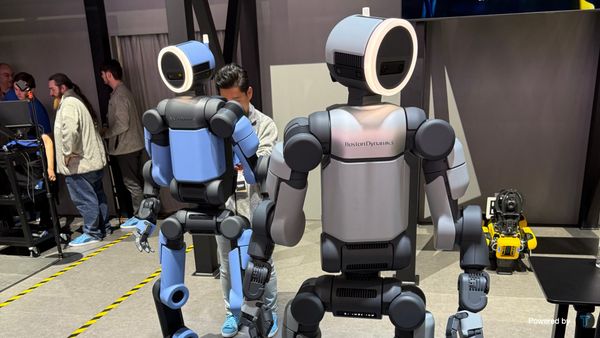
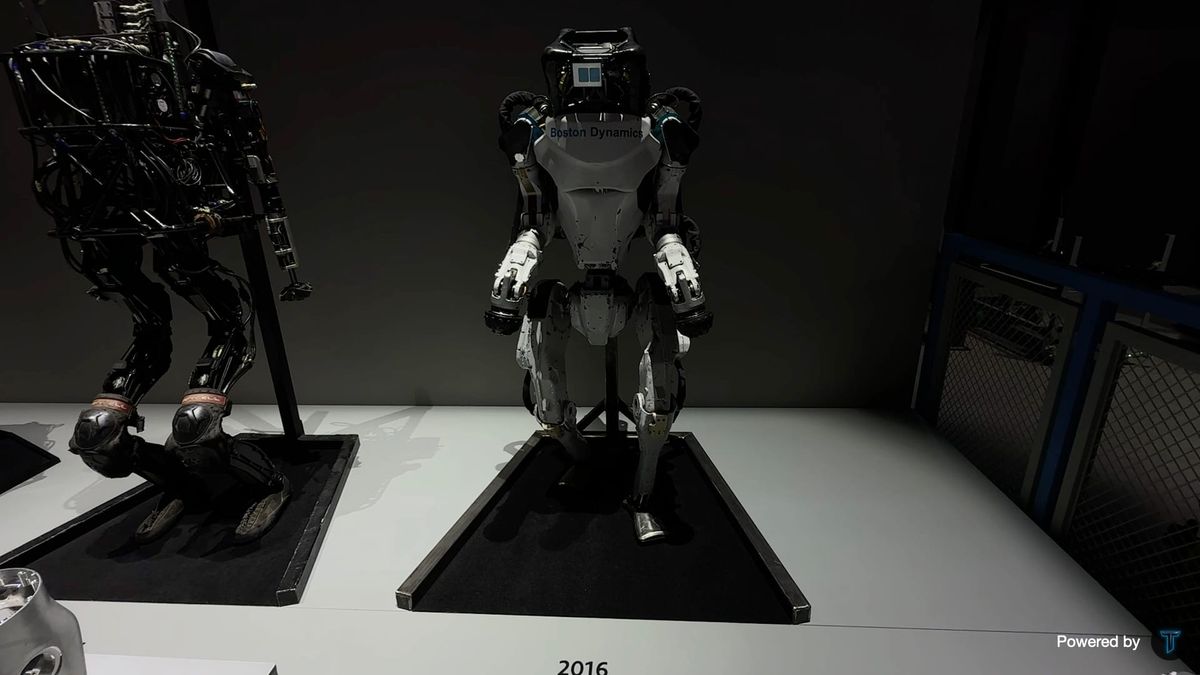
Then, in January 2026, I saw the latest Atlas at CES in Las Vegas.
Standing next to it were three much older machines.
The 3D Biped from 1990. The PETMAN prototype from 2007. And the hydraulic Atlas from 2016.
I was looking at more than 30 years of robotics research in one place.
But what interested me most wasn't the latest robot's movement.
It was what Boston Dynamics was now building it to do.
The company had introduced the new electric Atlas as an industrial humanoid robot.
Its message was simple: "Built for Work."
Production of the new Atlas had begun, with units planned for deployment at Hyundai Motor Group and Google DeepMind in 2026.
This was a different goal from the one Atlas had pursued for years.
The question was no longer whether Atlas could perform an impressive movement in a laboratory.
It was whether the robot could do useful work in a factory, day after day.
Why Boston Dynamics Taught Robots to Jump
To understand how Atlas reached this point, we need to go back to the 1980s.
Marc Raibert, the founder of Boston Dynamics, was studying how robots could maintain their balance while moving.
Instead of trying to keep robots standing in one stable position, his research focused on machines that could hop, run, and recover their balance.
Consider what happens when a person walks.
The body moves forward. Weight shifts from one leg to the other. Each step changes the body's balance.
A walking robot faces the same basic problem.
It needs to measure its position and speed, decide where to place its next foot, and calculate how much force each joint should produce.
And it needs to keep making those calculations as it moves.
At CES 2026, I filmed the 3D Biped from 1990.
Compared with today's Atlas, it looked like a relatively simple experimental machine.
But it represented an important stage in the development of dynamic balance.
Without this early research, the running, jumping, and backflips that came later would have been much harder to achieve.
The backflip wasn't simply a demonstration for an audience.
It showed how precisely the robot could control its entire body during a difficult movement.
Over time, Boston Dynamics combined this work with whole-body control, perception, and object manipulation.
Then, in 2024, the company retired its hydraulic Atlas and introduced a fully electric version.
Electric actuators offered a way to reduce some of the complexity and noise associated with hydraulic systems, while improving energy efficiency.
But the company's ambitions went further.
It wanted a machine that could be operated and maintained in an industrial workplace.
The Factory Test
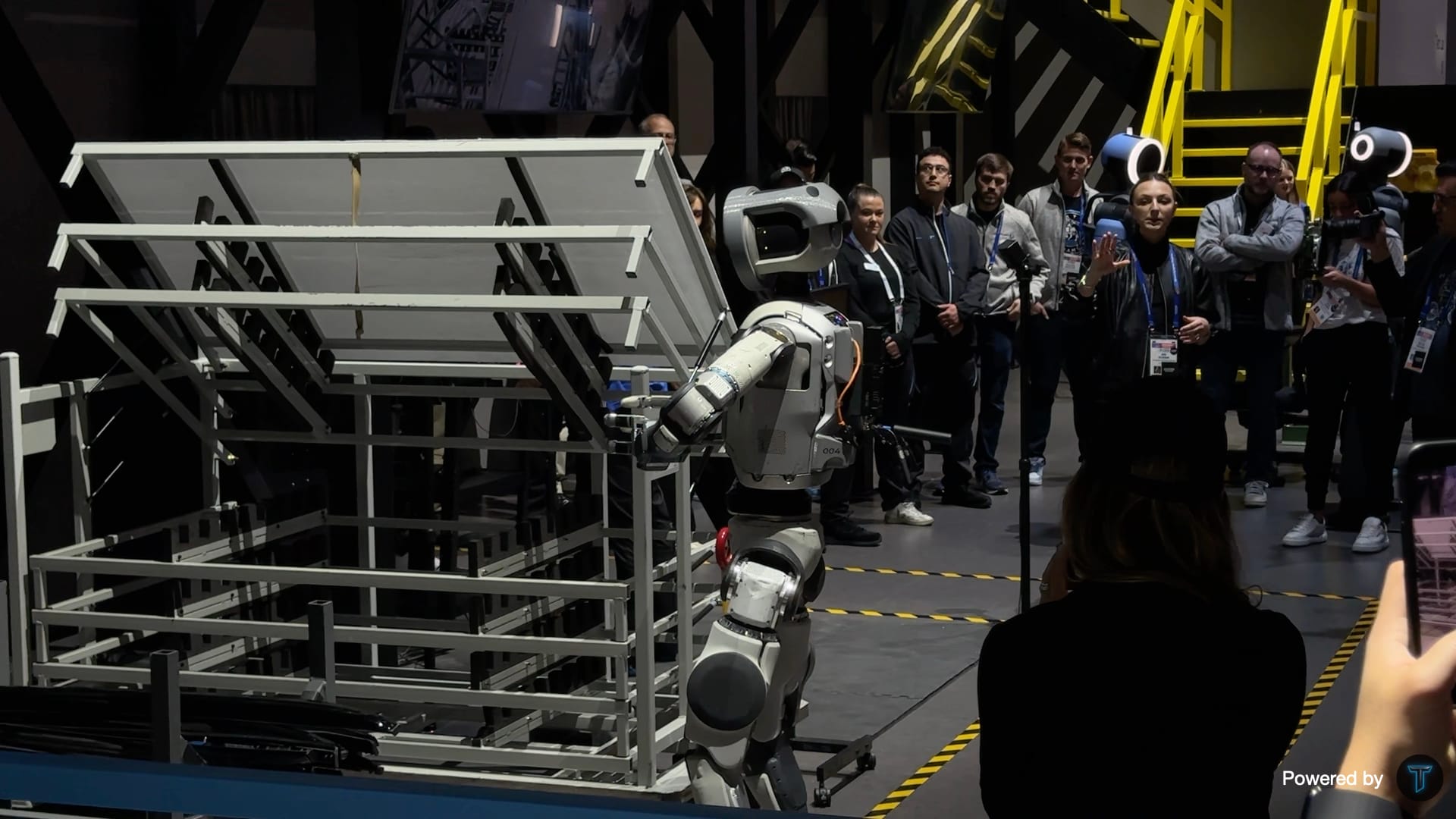
On September 21, 2026, Hyundai Motor Group opened the Robotics Metaplant Application Center, or RMAC, at its manufacturing complex in Georgia.
The facility is designed to train and test Atlas for automotive manufacturing.
One of the first areas of work is parts sequencing.
This involves bringing components to the production process and arranging them in the order needed for assembly.
The work may look simple compared with a backflip.
But a factory creates problems that a controlled demonstration doesn't fully reveal.
A robot needs to repeat the same task thousands of times.
It needs to recognize errors, recover when something goes wrong, and continue operating reliably.
Maintenance costs matter. So does the amount of time the robot can work without interruption.
Atlas is now being trained and tested in a real manufacturing environment.
That does not mean thousands of Atlas robots are already working on production lines.
The company is still testing how the technology can be used in manufacturing.
Boston Dynamics also plans to expand the training facility to roughly ten times its current size in 2027.
This brings me back to a question I raised when I analyzed Atlas three years ago.
Building one expensive experimental robot that can perform extraordinary movements is one challenge.
Manufacturing tens of thousands, or even millions, of capable robots at a reasonable price is another.
At the time, this was largely a question about the future.
Now, companies are beginning to test the answer inside actual factories.
China's Humanoid Robot Competition
The United States isn't the only place where this is happening.
In August 2026, Beijing hosted the second World Humanoid Robot Games.
The event registered 666 teams and 2,056 robots.
There were 51 competition events, including 21 based on practical scenarios.
Some tested robots in settings designed to resemble factories, hotels, and other working environments.
That matters because performing a task in a competition is different from performing it reliably in a workplace.
A robot may complete a task successfully under controlled conditions.
That doesn't tell us how it will perform during months of daily operation.
Still, these competitions show where much of the research is heading.
Engineers are testing not only how robots walk or run, but also how they handle objects and complete tasks in environments designed for people.
The difficult part is turning those demonstrations into machines that businesses can use every day.
What Comes After the Backflip?
Looking back at Atlas, I see three major engineering problems that shaped its development.
The first was balance.
Could a robot move, jump, and recover without falling?
The second was interaction with its surroundings.
Could it recognize obstacles, adjust its movements, and handle objects without losing control?
Boston Dynamics spent decades working on these problems.
The third problem is the one Atlas faces now.
Can those capabilities be used reliably in a factory, at a cost that makes sense?
There are still major questions.
How much will each robot cost to manufacture?
How much maintenance will it need?
How reliably can it work over long periods?
And how much training will be required when the robot moves to a different task?
There is also a more basic question.
When does a humanoid robot offer a real advantage over an existing industrial robot or automated machine?
Not every job in a factory requires a machine shaped like a human.
These questions will determine how far Atlas can go beyond its demonstrations.
When I saw the different generations of Atlas displayed together at CES, the progress was easy to recognize.
What began as research into balance had developed into machines capable of complex movements and object manipulation.
Now Boston Dynamics is trying to use those capabilities in manufacturing.
The backflip showed what Atlas could do with its body.
The factory will show whether it can do useful work, repeatedly, reliably, and at a reasonable cost.
And the next important moment in the history of Atlas may not be another spectacular demonstration.
It may be an ordinary day in an automotive factory, when the robot completes thousands of tasks without a problem.
For research inquiries or collaboration, contact: ceo@technorns.com