NASA's Saturn V and the Normalization of Space Exploration
Why can't we rebuild NASA's Saturn V? Sun Lee explores the limits of aerospace blueprints, Cold War anomalies, and SpaceX's Starship normalization at Starbase.

After more than a decade of conducting due diligence on companies and evaluating global expansion strategies, I have learned a foundational truth: while artificial intelligence can instantly summarize the world's data, it cannot replace the reality of the field. The most critical insights only emerge when you visit the site, observe the operations, and speak directly with the engineers.
Too many analysts rely on finished products and corporate slide decks. My work, however, has taken me directly to factory floors, spanning blast furnaces, AI labs, pharmaceutical cleanrooms, and aerospace facilities. This experienced taught me early on that technology does not live on spreadsheets; its real substance is found in the grit of active deployment.
This conviction drove me to Houston to see the Saturn V at NASA Johnson Space Center before traveling to Starbase in South Texas. The sequence was deliberate. To understand the current boundary of aerospace, one must first confront the absolute peak of the past. The old rule of seeing for oneself holds just as true in engineering as it does in business.
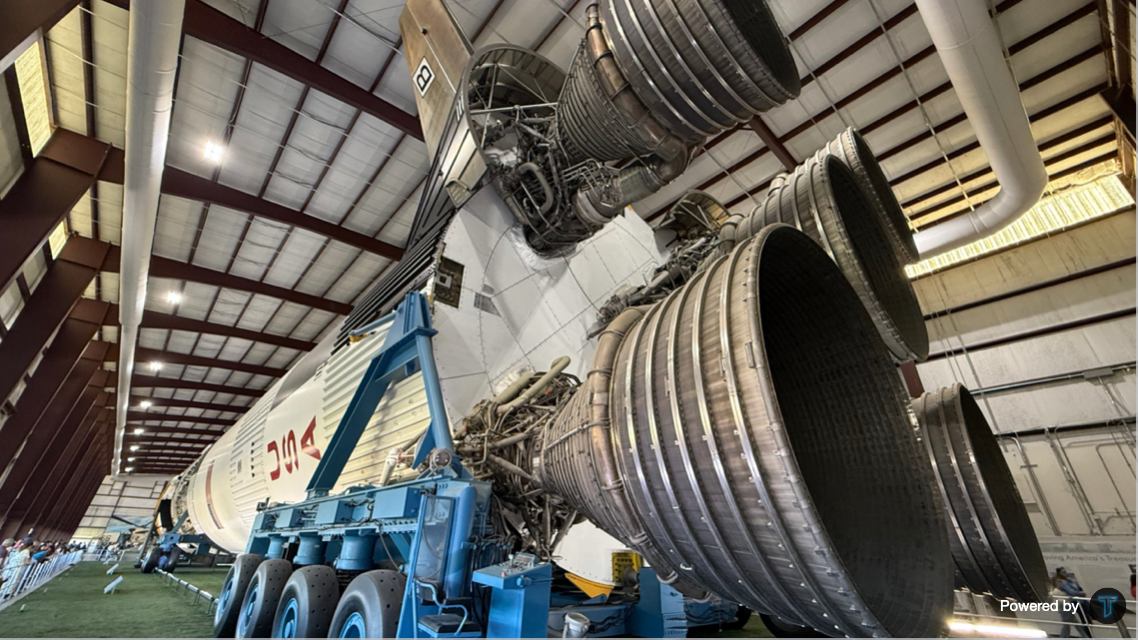
Walking into the Saturn V display pavilion, the scale immediately disrupts your expectations. This is no museum replica. Every single one of its three stages was built for actual flight, representing the only remaining Saturn V assembled entirely from real, flight-qualified hardware.
The first stage was destined for Apollo 19, the second for Apollo 20, and the third for Apollo 18. When these missions were canceled due to budget cuts, these stranded stages were eventually gathered in Houston and assembled into a single vehicle. A genuine spacecraft that could have carried humans to the moon rests quietly on its side.
Standing near the first stage, you face the five F-1 engines. Each nozzle is 3.75 meters in diameter, easily large enough for an adult to stand inside. This machine, which once lifted 140 tons into orbit, is now a silent historical display. It is a striking reminder that the true scale of human achievement is rarely captured on a screen; it must be experienced in person.
More than half a century after Apollo 11, Elon Musk noted a profound engineering reality: reaching the moon in 1969 was not the result of natural, linear technological progress. It was a historical anomaly driven by an intense national consensus that essentially pulled future technology into the present.
This observation highlights a classic engineering paradox. The Saturn V, humanity's most astonishing aerospace achievement, was built through abnormal, non-market mechanisms. Under normal peacetime conditions, the rocket could not have existed in the 1960s. Only the extreme pressure of the Cold War forced this physical impossibility into reality.
This historical detour leaves us with a sobering fact: although the blueprints for the Saturn V are preserved, we cannot simply rebuild it. Modern engineering teams cannot just print the drawings and assemble a functioning rocket.
A machine of this scale is not merely the sum of its blueprints. It is the physical manifestation of a highly specialized industrial ecosystem, implicit manufacturing knowledge, custom tooling, and a specific social consensus. When the Apollo program ended, the capability to build the Saturn V dissolved alongside its supporting infrastructure. The drawings remained, but the invisible network that made them work was gone.
This is why the rapid, iterative trials of Starship in South Texas are so significant. They are not just commercial ventures; they are a necessary effort to normalize a stalled technological timeline. Instead of relying on unsustainable, state-driven anomalies, modern aerospace is trying to build a repeatable, economically viable ecosystem to ensure that the path to the stars is built to last.
For research inquiries or collaboration, contact: ceo@technorns.com