One Man's Certainty Is Worth Less Than Thirty Scorecards
Only one company took two Best of Innovation awards at CES 2026. The judges' reasoning stays sealed, but the text they scored is public. What Oshkosh put in front of thirty scorecards, and why it held.

Steve Jobs thought the Segway would matter as much as the personal computer. John Doerr, the venture capitalist who backed Google and Amazon, said the company might reach a billion dollars in sales faster than any firm in history. Dean Kamen, who invented the thing, expected to be shipping ten thousand units a week within a year.
In May 2009, TIME ran a list of the decade's ten biggest technology failures, compiled by Douglas A. McIntyre of 24/7 Wall St. The Segway made it. The numbers in that piece are worth repeating. The company spent roughly $100 million on development. Between 2001 and the end of 2007 it sold thirty thousand units. TIME named two causes. Most models cost well above $3,000 and some ran to $7,000, which priced the machine out of any mass market. And the legal status was a mess, classified as a road vehicle requiring a license in some countries, banned from roads outright in others.
Adam Grant uses this story in Originals for a reason that has nothing to do with the machine itself. What failed was the structure of the judgment.
The eye that scores your own business is broken
Arnold Cooper, Carolyn Woo and William Dunkelberg published the classic study on this in the Journal of Business Venturing in 1988. They surveyed 2,994 Americans who had started businesses in 1984 and 1985, running the questionnaire in May 1985 through the National Federation of Independent Business.
Two questions. Rate your own business's odds of success out of ten. Then rate the odds for other businesses started under similar conditions.
Own business: 8.1 on average. Comparable businesses run by other people: 5.9. Eighty-one percent gave themselves seven or better. Thirty-three percent gave themselves a perfect ten. The researchers had gone in expecting cautious optimism, since prior survival data suggested fewer than half of new firms last five years under the same owner. They found the opposite.
The finding that should worry anyone is buried further down. Founders who were poorly prepared were just as optimistic as founders who were well prepared. Confidence carried no information about competence.
So the same person holds two different instruments. One reads 8.1 and one reads 5.9, and only the first switches on when the object being measured belongs to you.
Grant lists three things that pushed Jobs into overvaluing the Segway. He had no experience in the field. He was arrogant. He was excited. Jobs knew digital technology. He did not know transportation, and he was known for making large investment calls on instinct rather than systematic analysis.
Grant's remedy is simple to state. Gather other people's judgments, preferably from people who have demonstrated creativity in the domain being judged.
The CES Innovation Awards are that remedy turned into a procedure
The CES Innovation Awards 2026 program took more than 3,600 submissions across 36 product categories. A panel of third-party industry experts reviews them category by category.
You can find out who those people are. CTA publishes a judges gallery on its judging platform in late October each year, and only judges who complete their assigned reviews appear in it. When Oshkosh referenced the panel in its own award announcement, that gallery is what it linked to. Open it and count affiliations and you will see which companies did the scoring. For the CES 2025 program, that count included five people from Google, four from Amazon, one each from Apple and Microsoft, and two from Abbott, alongside a great many others.
Four features of this arrangement map directly onto Grant's argument.
It is not one person. Instead of Jobs on his own, each category gets multiple experts scoring independently against the same rubric. In Cooper's terms, the judging happens through the 5.9 instrument rather than the 8.1 one, and the 5.9 instrument is the accurate one.
The domain matches. Judging is split by category, so robotics entries go to robotics judges. That is the inverse of Jobs assessing a vehicle.
Excitement has nowhere to enter. Judge scoring is final. CTA does not release individual scores and does not give feedback. There is no channel through which an applicant can lobby, appeal, or re-argue. The point in the process where enthusiasm would normally leak in has been sealed.
And the rubric is fixed. Engineering and functionality. Aesthetic and design. What makes the product unique and innovative. Honorees are the products scoring above the threshold in a category. Best of Innovation goes to the highest scorer among them.
Of the 3,600-plus entries, thirty came out the far end at the top grade. That is about 0.83 percent. Whatever else it is, it is not comparable to one person's hunch.
Oshkosh cleared the gate twice, in two different fields
Only one legal entity took two Best of Innovation awards at CES 2026. Go through the thirty top-grade entries and Oshkosh Corporation is the only company name that appears twice. Robotics, for the JLG Boom Lift with Robotic End Effector. Travel and Tourism, for the Striker Volterra electric airport rescue and firefighting vehicle. Add two Honoree citations in Construction and Industrial Tech and the total is four.
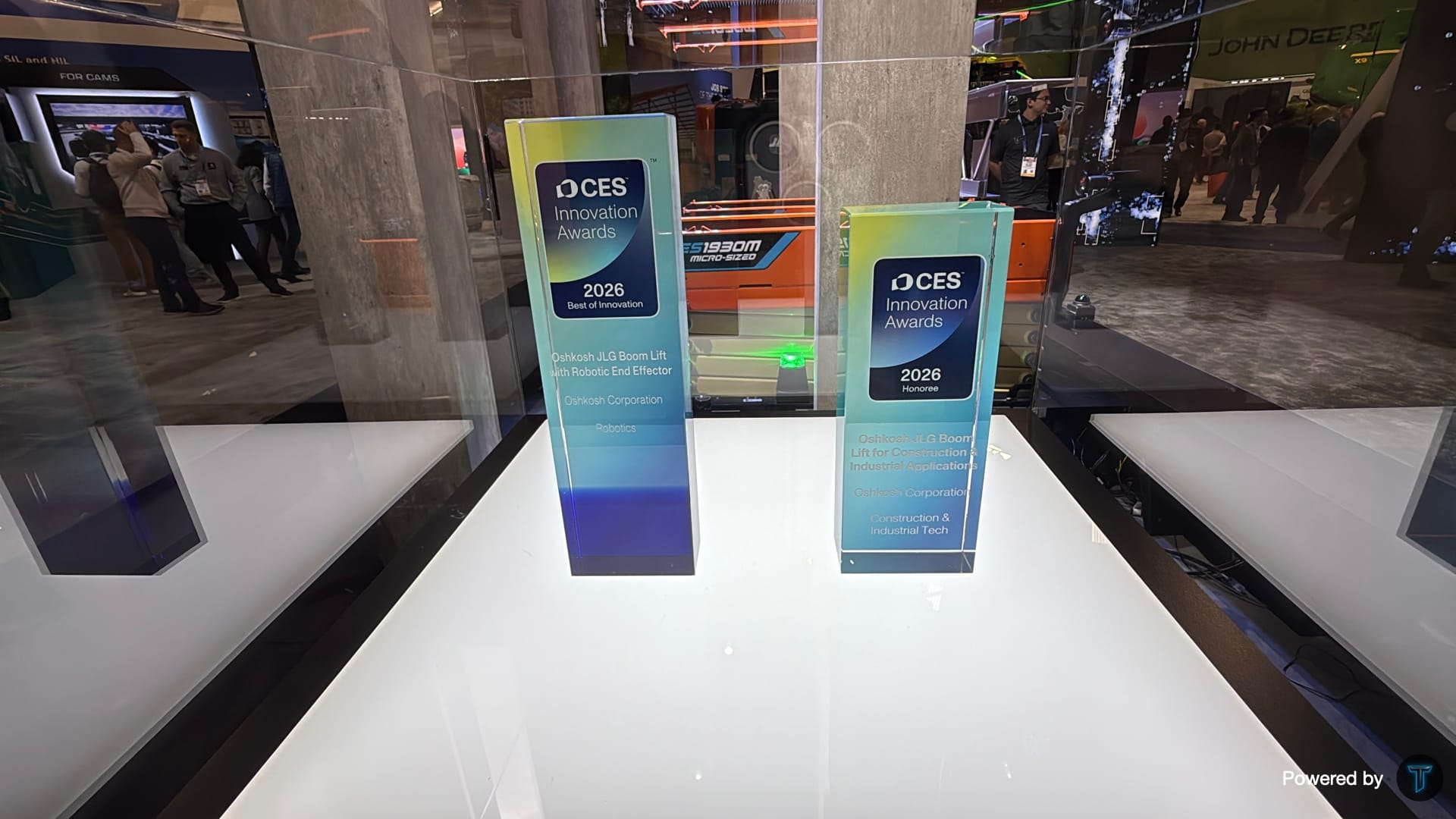
The trophy case in the JLG zone shows how that was assembled. Two awards stand side by side, engraved under different product names: the Boom Lift with Robotic End Effector, Best of Innovation in Robotics, and the Boom Lift for Construction and Industrial Applications, an Honoree in Construction and Industrial Tech. One product family, filed twice, judged twice.
Two separate panels, drawn from two separate fields, arrived at top marks independently. That leaves much less room for a single panel's taste to explain the result.
The robotics gate was the tighter of the two. Submissions in that category rose 32 percent year over year, tied with drones for the sharpest increase and ahead of AI at 29 percent. Out of that surge, exactly one Best of Innovation emerged. Oshkosh took it.
Both halves of Amabile's definition
Teresa Amabile is Baker Foundation Professor at Harvard Business School and Edsel Bryant Ford Professor of Business Administration, Emerita. She trained as a chemist and worked as one before taking a psychology doctorate at Stanford, and she has spent forty-five years studying how creativity is produced and how it is killed. She built the componential theory of creativity and wrote Creativity in Context and The Progress Principle.
Her theory rests on a definition. Creativity is the production of ideas or outcomes that are both novel and appropriate to some goal. Novelty alone does not qualify. An invention has to be new and it has to work for someone.
The Segway scored full marks on novelty and failed on appropriateness, in exactly the way TIME described. The price excluded the mass buyer and the law gave the machine nowhere to ride. Add the ordinary questions nobody answered. Where do you lock it. Where do the groceries go.
Look at what Oshkosh put in front of judges and both halves are covered.
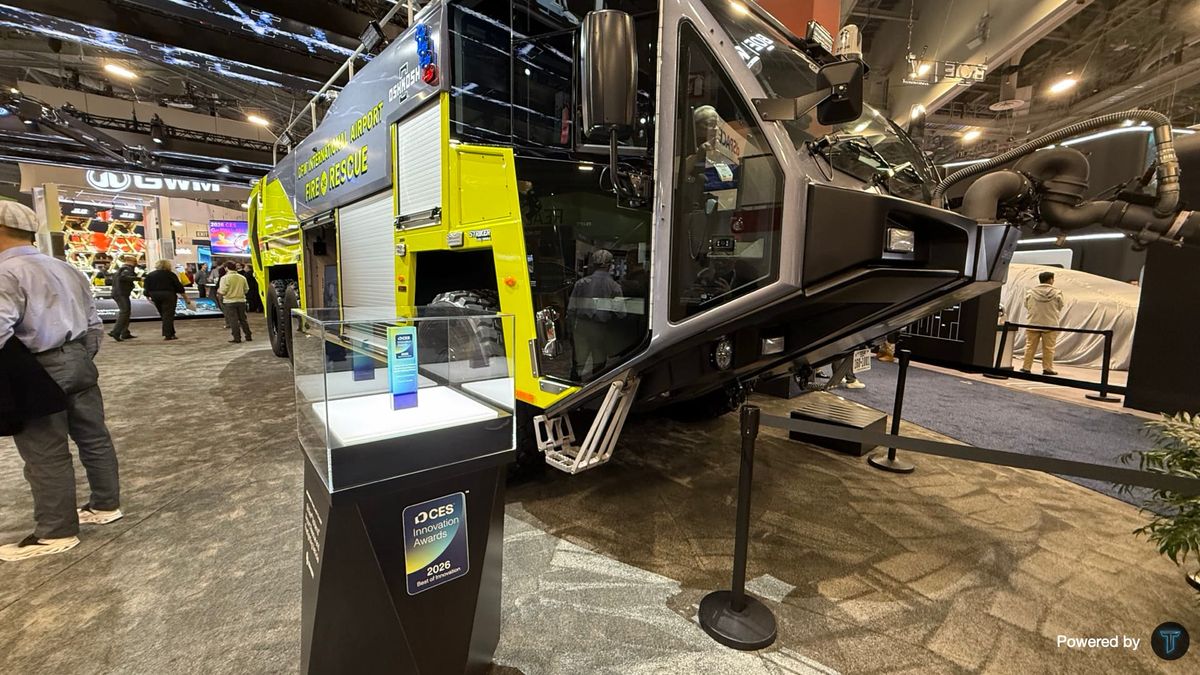
The Striker Volterra accelerates to an incident scene 28 percent faster than the company's own diesel ARFF. That comparison is against Oshkosh's own previous product rather than an industry average, and no absolute acceleration figure has been published. What sits underneath it, though, is third-party: certification to National Fire Protection Association 414 and International Civil Aviation Organization standards, including the three-minute response rule. That is a claim cut against an external norm rather than asserted by the applicant.
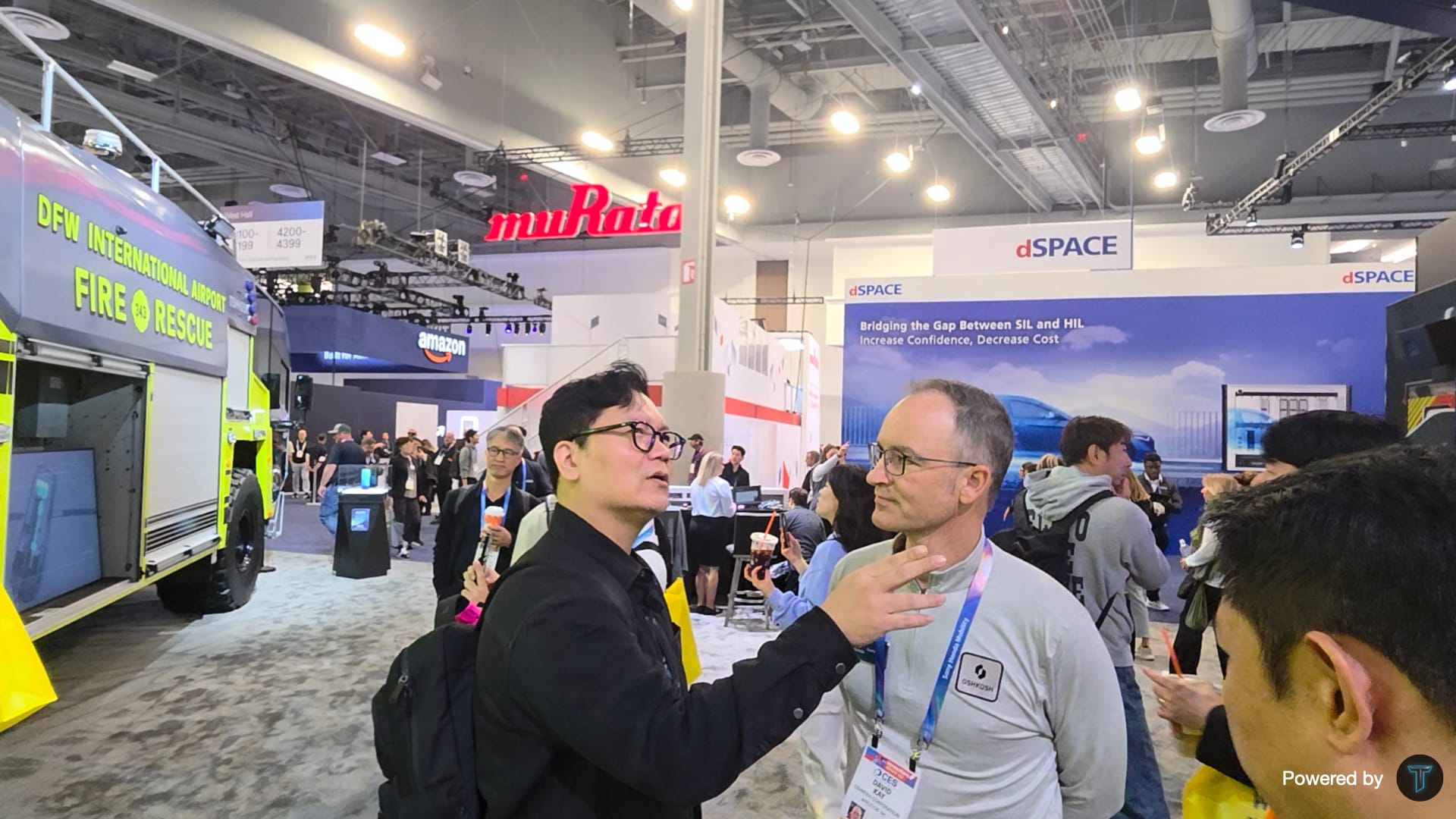
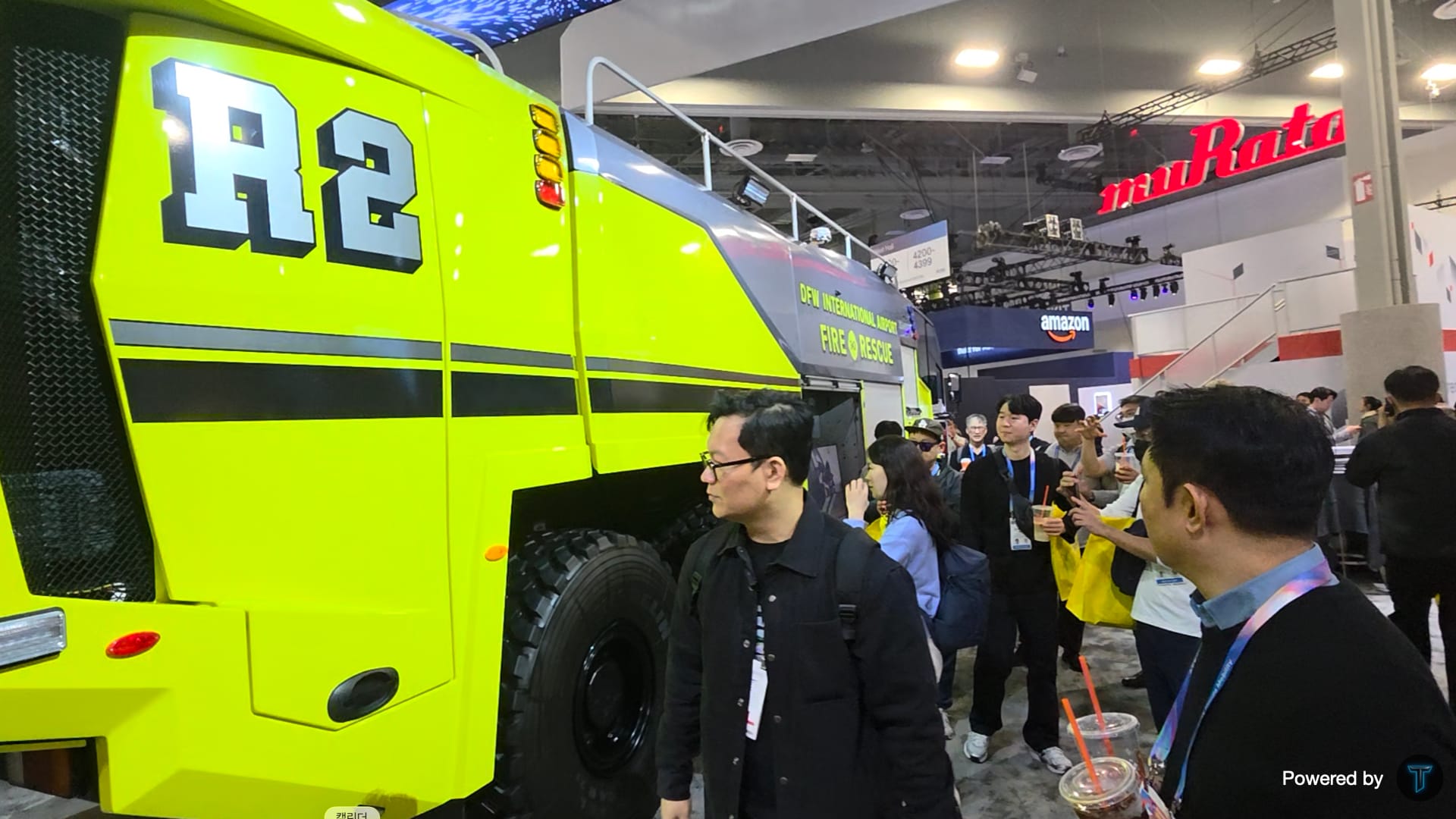
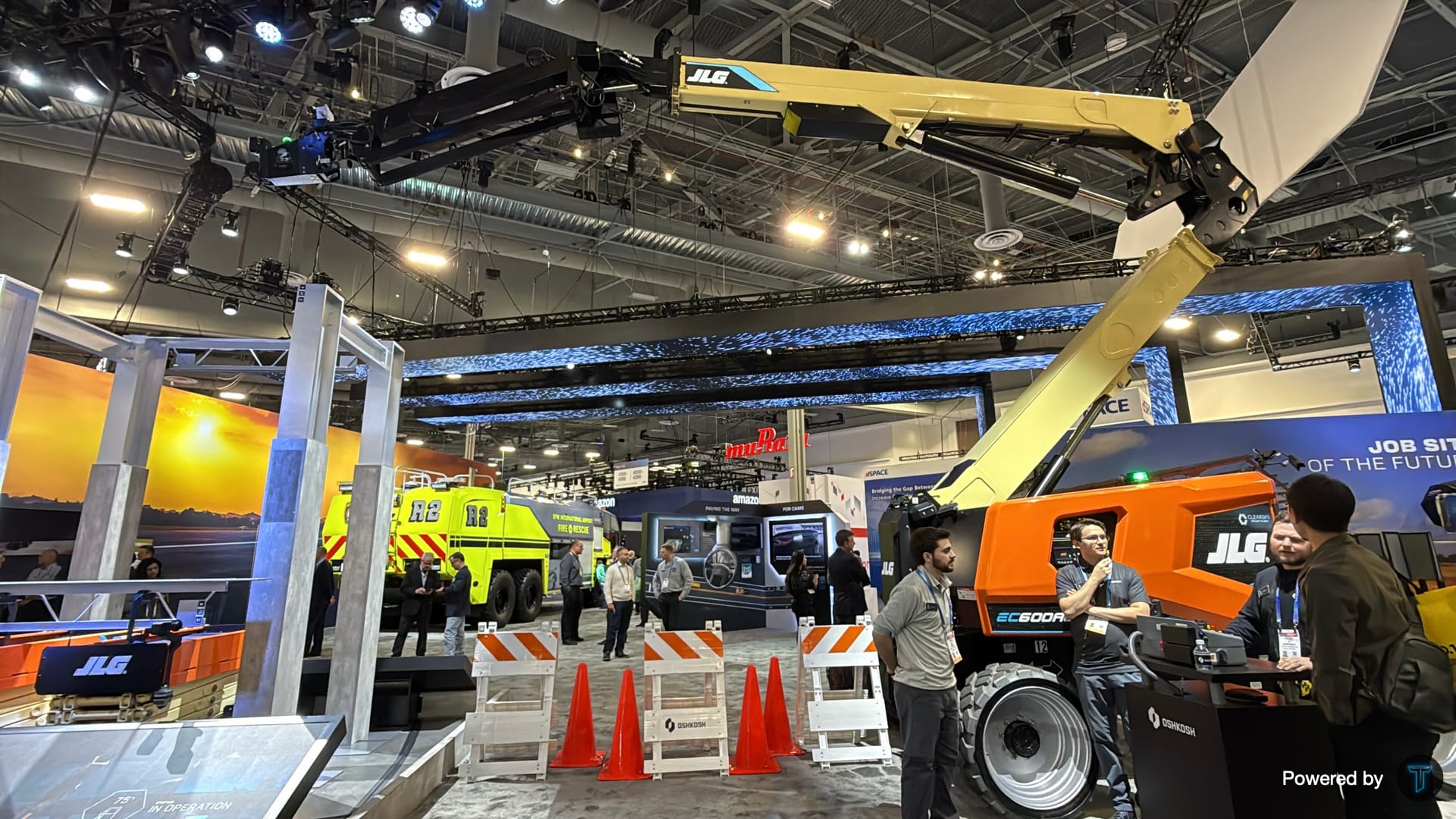
And the truck on the show floor was not a display build. It carried a DFW Airport Fire Rescue badge, unit number R2, and a Texas exempt plate. It was a working vehicle pulled off duty at Dallas Fort Worth.
Bill Sahlman, who studies entrepreneurial finance at Harvard Business School, makes the point that products do not create value. Customers do. The Segway never found that customer. The Striker Volterra already had one, paying and operating. When a judge fills in the functionality line on the scorecard, that difference converts into points.
The JLG robotic boom lift is still a concept. The chassis carries an EC600AJ+ badge on its side panel, and where the work platform would normally sit there is an articulated black robotic arm. A machine that used to lift a person up has become a machine that lifts a tool up. The demonstration was not autonomous operation either. Oshkosh-branded barricades and traffic cones ringed the area, uniformed staff stood by, and the only structures inside the arm's reach were mock concrete columns and steel beams.
Those mock structures matter more than they look. The official description names welding, inspection and installation as the intended tasks. The demonstration set reproduced precisely the environment where that work happens. The marketing copy and the physical demo did not contradict each other, and the system claim attached to it is specific: integration with digital twins and jobsite management platforms. For a machine that has not shipped, that is close to the best available answer on the appropriateness axis.
People who read the rules have an advantage
A short detour into practical ground.
Under current rules a single product can be entered in up to four categories. Each category carries its own fee, and the product is eligible to win in each one provided it fits the category definition. If you are working from older material that says three, that was an earlier cycle. Check the source document every year.
The belief that each category yields exactly one top award is also wrong. The rules state plainly that CTA reserves the right to withhold Best of Innovation in a category or to award multiple winners, based on judge scoring. At CES 2026 that produced two top awards in Travel and Tourism and three in Artificial Intelligence.
Scroll the honoree gallery and you can see multi-category entries with your own eyes. Samsung Electronics America's S3SSE2A carries two badges and two category tags, Cybersecurity and Embedded Technologies. Strutt's electric wheelchair from Singapore carries Vehicle Tech and Advanced Mobility alongside Accessibility and Longevity.
Fees for the CES 2027 program run $799, $999 and $1,199 depending on when you file, with exhibiting member rates of $399, $599 and $799. Fill all four category slots and you are looking at roughly $1,600 to $4,800.
Timing eligibility trips people up. The product must first reach the market between April 1, 2026 and March 31, 2027. A crowdfunding listing counts. A pre-sale period does not. Entries close August 19, 2026. Judge applications close July 10, with selection notices going out August 19.
What the award certifies and what it does not
CTA states on its own page that it does not test or endorse Innovation Award winning products.
That line defines the scope of the award rather than diminishing it. What the panel scored was engineering and functionality, aesthetic and design, and innovation. Placing in the top 0.83 percent of 3,600 entries on those three axes is a real result. It is not a forecast of unit sales.
Grant's argument only ever went that far too. He is not claiming that pooled expert judgment predicts revenue accurately. He is claiming it beats one insider's conviction by a wide margin. The score Jobs gave the Segway and the score a robotics panel produces against a fixed rubric are not equally trustworthy, and the reason is not that the panel is flawless.
Come back to the most uncomfortable line in the Cooper study. The badly prepared founders were exactly as confident as the well prepared ones. Self-belief carries no signal about capability. If that is true, the signal has to come from somewhere else, and the only place left is the score somebody else assigns you.
Jay Iyengar, Oshkosh's chief technology officer, said in the award announcement that the company builds practical solutions for the people shaping the future of airports, neighborhoods and jobsites. Walk the booth and that sentence is the floor plan. The Striker area sits under a header reading Shaping the Future of Airports. The adjacent zone is Neighborhood of the Future. The JLG area is a jobsite mockup. The Best of Innovation trophy stands directly in front of the Striker, where every visitor has to pass it. The McNeilus Honoree trophy sits alone in the neighborhood zone with no product beside it, while the two JLG awards share a single case inside the jobsite zone. The plinths and acrylic cases are the same design throughout, so the grade reads off the engraved text, while the placement tells you which product the booth wants you to look at.
One message, repeated identically across the entry documents, the press release and the physical zone names. A judge who read that structure on paper meets it again on the floor.
Why any individual product won is not disclosed and will not be. We cannot know what the judges saw when they gave it top marks. What is disclosed is who did the judging and under what structure, and that structure is worth more than one person's instinct. That is the lesson the Segway left behind.
This article is based on first-hand reporting at CES 2026, including photographs taken on the show floor by the author. Figures are drawn from CTA and CES official publications and company press releases. Award program rules and fees change annually and are current as of publication. Corrections are welcome at ceo@technorns.com. AI tools were used in research and drafting. Final verification and editorial responsibility rest with the author.