
Starlink Absent at MWC Shanghai 2026
Starlink fuels SpaceX but requires carrier partners. In dense markets with 6.8M base stations, terrestrial infrastructure forms a structural wall rendering satellite broadband unnecessary.

The Terrestrial Wall: Why Infrastructure, Not Regulation, Limits Starlink's Grid

When SpaceX filed its Form S-1 with the Securities and Exchange Commission in May 2026, it placed a definitive number on its long-term ambitions: a total addressable market of 28.5 trillion dollars. While space and artificial intelligence command staggering projections, the connectivity segment holds a 1.6 trillion dollar opportunity, split between Starlink Broadband and Starlink Mobile. Yet, a crucial footnote quietly excludes China and Russia from these global estimates. On paper, it looks like standard regulatory housekeeping. On the floor of MWC Shanghai in July 2026, it reveals a completely different structural reality.
The financial data in the S-1 makes one thing clear: the rockets do not pay the bills. In 2025, the Connectivity segment generated 11.39 billion dollars in revenue and 7.17 billion dollars in segment adjusted EBITDA. Meanwhile, the Space segment posted an operating loss of 657 million dollars, dragging the consolidated company to a 2.59 billion dollar operating loss. Starlink is the financial engine funding the entire machine, operating roughly 9,600 low Earth orbit satellites serving 10.3 million subscribers across 164 countries.
However, scaling this financial machine requires a terrestrial bridge that may not exist in dense markets. The S-1 explicitly notes that Starlink Mobile relies on partnerships with terrestrial mobile network operators to secure regulatory approvals and access local spectrum. It is not a product you can simply ship from orbit; it requires the local incumbent carrier to say yes.
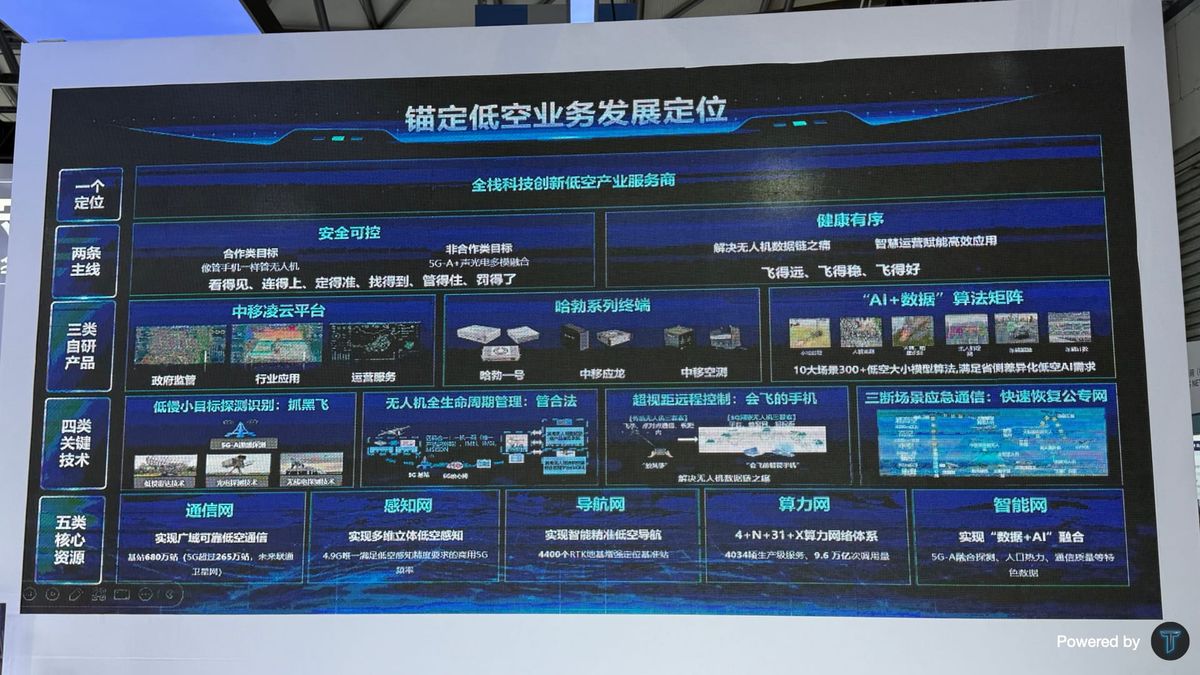
At the China Mobile exhibition booth, the structural wall becomes visible. The carrier displayed its low-altitude strategy founded on five core resource networks: communications, sensing, navigation, computing, and intelligence. Under the communications tier, the operator listed its infrastructure metrics: 6.8 million base stations, including more than 2.65 million 5G installations. Tucked into a parenthesis at the end of the line was a revealing phrase: enabling the satellite network in the future.
Satellite communication was not framed as a core pillar. It was treated as a footnote inside a terrestrial infrastructure network, scheduled for integration at the carrier's own convenience. In an environment with millions of operational base stations, satellite broadband loses its core value proposition. Starlink Mobile needs a carrier partner to function, but a carrier with an unassailable terrestrial footprint has zero economic incentive to share its gate. In these dense, mature markets, Western satellite systems face a challenge far more permanent than changing political regulations: they are being rendered structurally unnecessary by installed infrastructure.
For research inquiries or collaboration, contact: ceo@technorns.com