TCL Moved Into the Space Samsung Left Behind
At CES 2026 TCL occupied the Central Hall floor Samsung vacated. The panel supply chain, shipment share, premium brands, Olympic sponsorship, and now the car cabin.

Start with the conclusion. What CES 2026 revealed about Chinese consumer electronics was not created on the show floor. It was the visible result of a transfer that happened years earlier in the panel supply chain, showing up for the first time as a floor plan.
Dead center in the Las Vegas Convention Center Central Hall, on the spot Samsung occupied last year, stood TCL. Hisense sat next to it. Dreame, the robot vacuum maker, sat next to Hisense, in the space SK Group used for its integrated booth a year ago. Samsung left the convention center entirely for a roughly 4,600 square meter standalone showcase at the Wynn Encore. Both choices are defensible. Which company owns the center of visitor traffic is not in question.
The panels went first
One word kept appearing in TCL's booth signage: CSOT, the company's display subsidiary. The WHVA 2.0 panel inside the X11L is CSOT's. Making your own components means controlling both cost and supply timing.
Korea handed this structure over. LG Display stopped producing LCD TV panels domestically at the end of 2022. In September 2024 it agreed to sell its Guangzhou 8.5-generation LCD fab and module plant stakes to CSOT for 10.8 billion yuan, roughly 2.03 trillion won. The transfer closed in April 2025 and CSOT renamed the line T11. TrendForce estimated that this single deal lifted CSOT's global large LCD capacity share by area from 19.3 percent to 22.9 percent. Chinese panel makers are now estimated to hold around 70 percent of the world's LCD TV panel supply.
Korean set makers buy panels from their competitors now. Where the pricing leverage sits does not need calculating.
Shipments crossed over in 2024
Omdia put the combined 2024 global TV shipment share of TCL, Hisense and Xiaomi at 31.2 percent, ahead of Samsung and LG's combined 28.4 percent. It was the first year Chinese brands passed Korean ones. The Chinese figure climbed from 24.4 percent in 2020 through 26.3, 28.4 and 29.6 percent. The Korean figure fell from 33.4 percent through 32.6, 31.3 and 29.8 percent. The lines simply crossed in 2024.
By company, 2024 shipment shares were Samsung 17.6 percent, TCL 13.9, Hisense 12.3, LG 10.8 and Xiaomi 5.1. The ranking was unchanged from the prior year but the gaps moved. Against 2023 figures of Samsung 18.6, TCL 12.5, Hisense 11.4 and LG 11.2, the two Chinese brands closed on the leader and pulled away from fourth place.
December 2025 produced a symbolic moment. Counterpoint Research's monthly tracker showed TCL at 16 percent, ahead of Samsung at 13 percent, TCL's first monthly win after Samsung had led for eleven straight months from January through November. TCL grew shipments 10 percent year over year, with large gains in Asia Pacific, China and the Middle East and Africa offsetting slight declines in North America and Western Europe.
That number deserves caution. For the fourth quarter as a whole, Samsung shipped 2 percent more units than a year earlier and stayed ahead of TCL. Counterpoint itself attributed the December result to year-end seasonality combined with regional demand timing. Research fellow Sujeong Lim noted that any single month's shipments can swing on inventory adjustments and logistics schedules. Reading one month as a structural reversal overstates it.
The quarterly data carries more weight. In the first quarter of 2026, Samsung held first place at 16.8 percent and TCL took second at 14.1 percent. The ranking held, but the gap narrowed from 4.1 percentage points in Q1 2025 to 2.7. Samsung's shipments rose 8 percent over the period while TCL's rose 22 percent. Counterpoint attributed TCL's growth to Mini LED LCD sets.
For context, the global TV market shrank 0.13 percent in 2025. This is a fight over position in a market that is not growing.
The premium line is showing cracks
Korea's real defensive line was revenue rather than units. On 2024 revenue share, Samsung led at 28.3 percent, followed by LG at 16.1, TCL at 12.4, Hisense at 10.5 and Sony at 5.4. In TVs above 2,500 dollars, Samsung held 49.6 percent and LG 30.2. LG kept its twelfth consecutive year at the top of OLED TVs, with 52.4 percent of units and 49.3 percent of revenue.
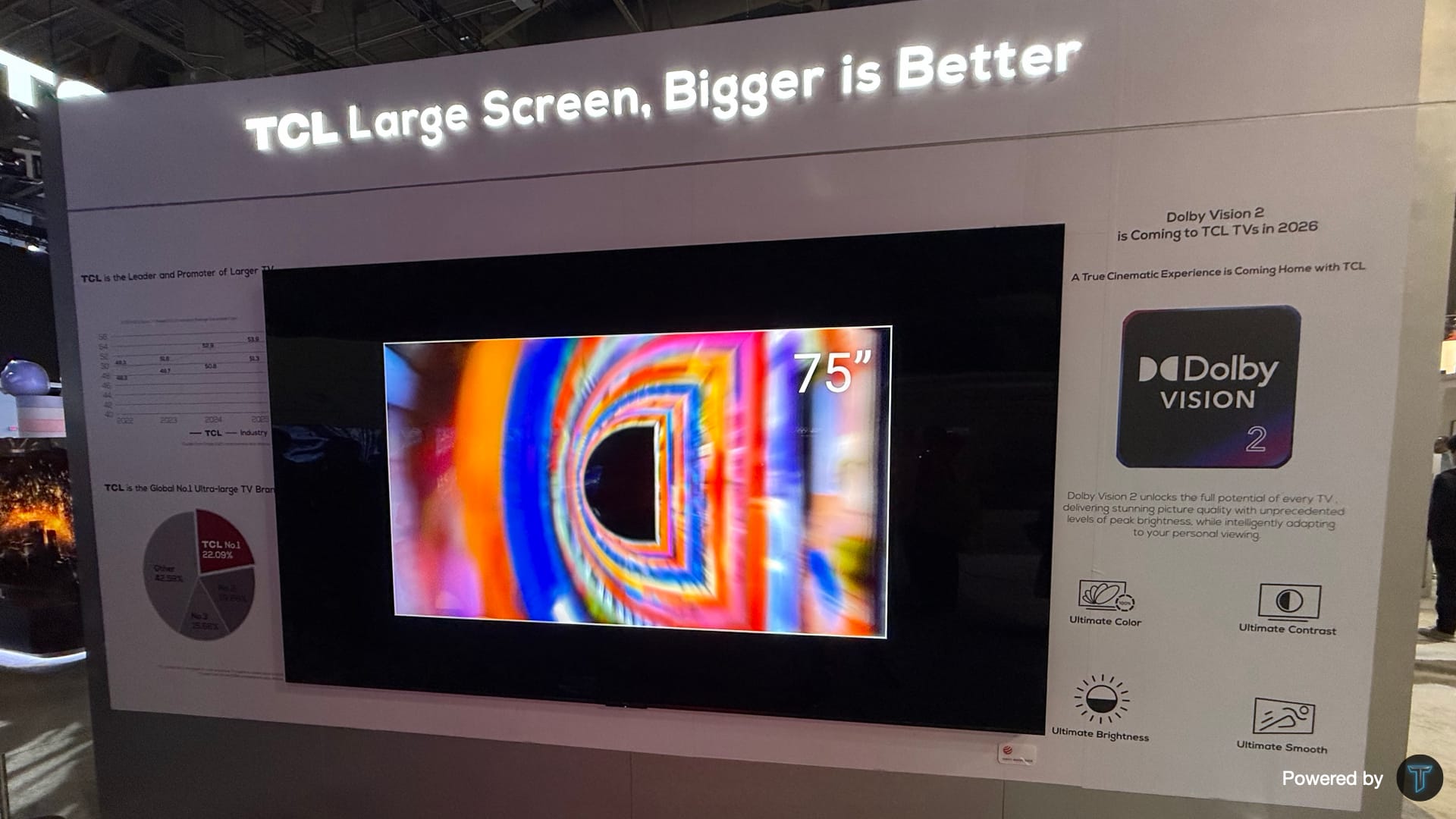
One tier down, the picture changes. In 2024 revenue share for TVs 80 inches and larger, Samsung led at 30.9 percent, followed by TCL at 17.2, Hisense at 14.0 and LG at 13.8. In the ultra-large segment, both Chinese brands already sit above LG. That is why TCL put its "Large Screen, Bigger is Better" wall and its self-reported ultra-large TV share pie chart on the same surface.
The overall revenue gap is closing too. Korean versus Chinese TV revenue share moved from 48.4 against 13.5 percent in 2020 to 44.4 against 22.9 in 2024. The Chinese side gained 9.4 points in four years.
TCL's premium weakness had a clear cause. It was the only major TV maker without an OLED lineup. Its answer at this CES is SQD-Mini LED. The X11L claims up to 20,736 precise dimming zones, peak brightness up to 10,000 nits, and up to 100 percent of the BT.2020 color gamut. Audio comes from Bang and Olufsen, software from Google TV with Gemini, and HDR from Dolby Vision 2, which TCL plans to push to its X and C series over the air during 2026.
The partner list is the more striking part. Google, Dolby and Bang and Olufsen supply Korean makers too. When the same stack can be licensed, the shelf life of software differentiation gets short.
The brand was acquired by contract
TCL and Sony signed an MOU in January 2026 and a definitive agreement on 31 March. The new joint venture is named Bravia, headquartered in Tokyo, owned 51 percent by TCL and 49 percent by Sony. It becomes a consolidated subsidiary of TCL and an equity-method affiliate of Sony. Kii Kazuo leads it.
The scope is wide. The venture inherits Sony's entire home entertainment business: consumer Bravia televisions, professional flat panel displays, professional LED displays, projectors, home theater systems and audio equipment, covering development, design, manufacturing, sales, logistics and customer service. Sony EMCS Malaysia, which manufactures these products, transfers to TCL in full. Transfer of manufacturing entities inside China remains under discussion.
The combined enterprise value of the transferred business and Sony EMCS Malaysia is roughly 102.8 billion yen, about 985 billion won. TCL's estimated consideration is roughly 75.4 billion yen, about 722 billion won, with the final figure to be fixed at closing after net debt and working capital adjustments. Subject to regulatory approval, the venture begins operating in April 2027.
The arithmetic shows the weight. Sigmaintell put 2025 shipments at 35.3 million units for Samsung, 30.4 million for TCL and 4.1 million for Sony. Adding TCL and Sony gives 34.5 million, closing the gap with Samsung to under a million units. Omdia's estimates produce a similar result, 36.4 million for Samsung against a combined 34.8 million. Sigmaintell projects TCL at 16.7 percent in 2027 against Samsung at 16.2. TrendForce sees the combined share approaching 20 percent.
TCL acquired a premium brand and a picture quality patent portfolio it could not build, for roughly 722 billion won.
The Olympic slot came the same way
Above the TCL logo on the booth ceiling hung the Olympic rings. In February 2025 TCL signed a Worldwide Olympic and Paralympic Partner agreement with the IOC running through 2032, in the home audiovisual equipment and home appliances category. The deal covers digital displays at Olympic venues, appliances in the Olympic Village, and participation in the IOC's Olympic AI Agenda.
The slot opened because Panasonic ended a 37-year relationship with the IOC after the 2024 Paris Games. Toyota and Bridgestone exited around the same time. GlobalData Sport valued Panasonic's final contract, covering 2017 through 2024, at roughly 320 million dollars.
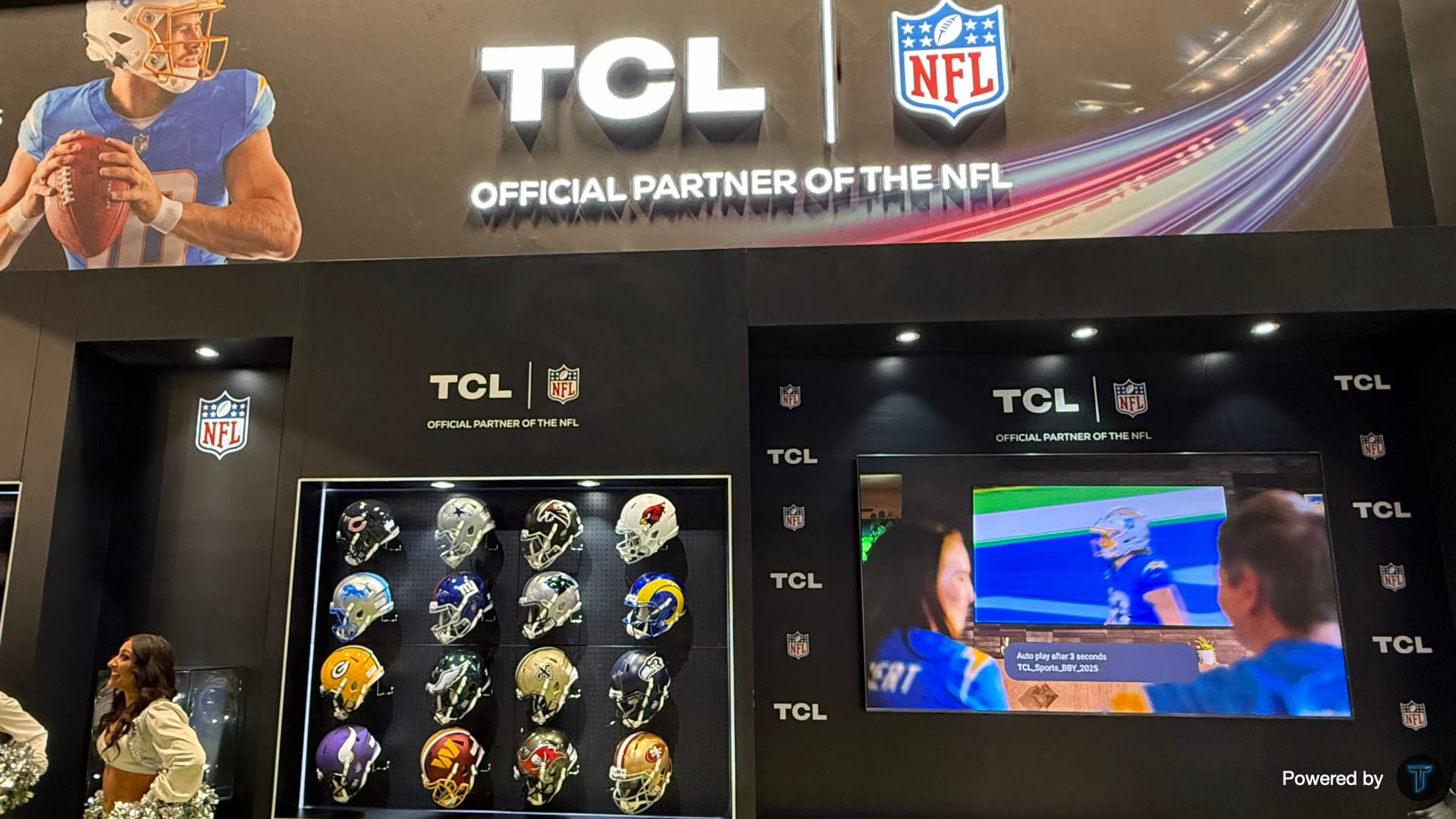
A separate NFL zone sat elsewhere in the booth. TCL is an official NFL partner and Los Angeles Chargers quarterback Justin Herbert is a brand ambassador. With 32 team helmets on display and a cheerleader on the floor, this was a marketing block aimed at American consumer sentiment rather than a technology exhibit. TCL repeatedly pointed to the February calendar, with Super Bowl LX and the Milan Cortina Winter Olympics landing in the same month.
A position Japanese companies built over decades passed to a Chinese company by contract. Same grammar as the Sony deal.
And then into the car
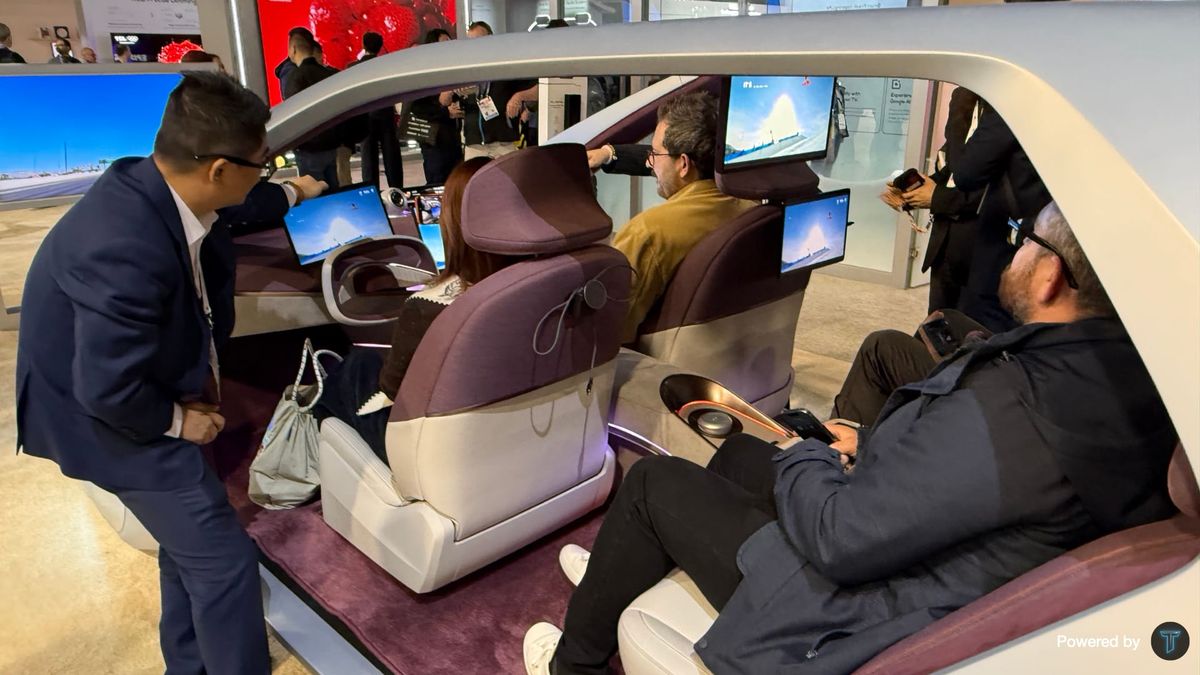
Past the NXTHOME zone sat a silver concept cabin mockup, positioned so that visitors walked out of a living room scenario and directly into the vehicle. This is the TCL Smart Cabin, part of what the company calls its Human by Vehicle by Home cross-scenario solution.
One point needs stating precisely. TCL is not entering autonomous driving. It does not build cars and it is not developing an autonomy stack. The target is smart cockpit displays and the user experience layer of the SDV cabin, the software defined vehicle. Blurring that distinction leads to misreading what the threat actually is.
Three reasons explain the move.
First, TV panel demand has stopped growing. Sigmaintell estimates global TV shipments of 218 million units in 2026, down 1.9 percent year over year. Automotive is one of the few growth segments left. Omdia projects AMOLED panel shipments rising from 1.01 billion units in 2024 to more than 1.33 billion by 2030, driven particularly by IT and automotive. CSOT's own framing of its business as "3+2+N," with automotive and professional displays carved out as the "2," reflects the same judgment.
Second, the margin structure differs. Automotive displays represent a low share of a vehicle's cost, so a higher panel price has limited effect on the final sticker. Larger and curved formats function as design differentiators, creating room for expensive panels. Prices do not collapse quarter over quarter the way TV panels do, and long-term supply contracts with automakers book years of revenue as backlog.
Third, the ecosystem story requires it. Holding both the home AI layer and the cabin screen lets a company bind house and car into a single scenario. Embedding the Smart Cabin physically inside the NXTHOME exhibit rather than in a separate mobility area makes the intent plain.
Execution is already underway. At CES 2025 CSOT showed a 3D AR-HUD built on a 5.5-inch LCD panel and a panoramic HUD using three 11.98-inch screens to replace the instrument cluster. At CES 2026 it ran a live demonstration of its HVA Ultra P-HUD, projecting information onto the windshield through a multi-LCD projection structure. At SID Display Week in May 2026 it introduced what it called the world's first 28-inch inkjet-printed OLED sliding central control display and 28-inch IJP OLED curved armrest display. In October 2025 it broke ground in Guangzhou on the world's first 8.6-generation IJP OLED line, the t8 project, with total investment estimated above 4 billion dollars.
This time the target is LG's growth engine
For Korea, this is more sensitive than television.
LG Electronics established its Vehicle Solution division in 2013 and ran losses for years before posting its first annual operating profit in 2022 and passing 10 trillion won in revenue in 2023. In 2025 VS revenue reached a record 11.14 trillion won with an order backlog around 100 trillion won. Its first quarter 2026 operating margin of 6.9 percent was the highest since the division was created. By LG's own disclosure, combined operating profit from VS and its Eco Solution division exceeded 1 trillion won for the first time in 2025.
In the same year, the Media Entertainment Solution division that handles television posted an annual operating loss of 750.9 billion won. After a small 4.9 billion won profit in the first quarter of 2025, it lost money in each of the following three quarters, with the fourth quarter loss alone at 261.5 billion won. Company-wide, LG Electronics posted record revenue of 89.20 trillion won while operating profit fell 27.5 percent to 2.48 trillion won. Automotive electronics is currently LG's clearest growth axis.
The panel side mirrors this. LG Display began mass production of a 40-inch automotive OLED aimed at SDV cockpits in February 2025 and returned to CES 2026 with a booth after a two-year absence, showing dual-view automotive OLED. Samsung Display launched its automotive OLED brand, Drive, in September 2025.
The pursuit looks familiar. In automotive OLED share, Tianma rose from 4.2 percent in 2023 to 11 percent in 2024, moving from seventh to fourth globally. Over the same period BOE went from 7.6 to 9.7 percent and CSOT from 6.7 to 7.6. The lever is the same one as before: a large domestic electric vehicle market as the demand base.
Korea still leads, and that is worth stating plainly. In 2025 Korean makers held 92.4 percent of the market for large OLED panels above nine inches, and every OLED TV panel in the world is made in Korea. Counterpoint Research nonetheless projects Chinese OLED capacity overtaking Korea's in 2029. There is no evidence yet that what happened in large LCD will not repeat in OLED.
Korea's answer leans on software
Samsung built its show around the theme "Your Companion to AI Living." LG lined its entrance with 38 units of the W6 wireless wallpaper OLED TV, roughly 9 millimeters thick, and put forward CLOiD, a home robot that sets task priorities based on schedule and surroundings and controls appliances directly. The direction is to avoid price competition and compete on the sophistication of the experience.
The strategy is sound. The problem is time, and some ground is already lost. IDC put Roborock first in the global robot vacuum market in the second quarter of 2025 at 21.8 percent, ahead of Ecovacs, Dreame and Xiaomi. In Korea itself Roborock holds more than 45 percent by revenue, and by its own count above 50 percent. A Chinese brand leads in Samsung and LG's home market.
In May 2026 it emerged that Park Hyoung-sei, head of LG Electronics' MS division, had met senior Hisense executives in Beijing, followed by reports of discussions on restructuring that included a possible sale of the TV business. LG Electronics denied it. Hisense said only that contact between companies is routine. Omdia considered an acquisition unlikely, noting LG still ranks second by revenue. Counterpoint nonetheless ran the numbers: an LG and Hisense combination would hold 21 percent of 2025 shipments, above both Samsung and the Sony-TCL pairing. Counterpoint puts Hisense at 12 percent and LG at 9 percent for 2025, third and fourth.
The open question
Walking the TCL booth produced something closer to a procurement list than a product list. The panel fab came from LG Display. The premium brand and picture quality patents came from Sony. The Olympic marketing asset came from the slot Panasonic vacated. Where nothing was available to buy, TCL put technology it has pushed for over a decade, CSOT's inkjet-printed OLED and SQD-Mini LED.
Korean companies still hold cards. Revenue share above 2,500 dollars, 92.4 percent of large OLED, platform income from webOS and Tizen, an automotive order backlog around 100 trillion won, and a next round in robotics and AI appliances. Those cards hold their value only as long as the other side cannot buy the same ones.
Bravia begins operating in April 2027. That leaves eighteen months.
For research inquiries or collaboration, contact: ceo@technorns.com
This article was researched and written by the author. Figures and statistics are drawn from official published materials, but the research and calculations were performed by a person and may contain errors. Satellite counts and fleet figures change weekly and are current as of publication. Corrections are welcome at ceo@technorns.com. AI tools were used in research and drafting. Final verification and editorial responsibility rest with the author.
Sources
TCL CES 2026
- TCL CES 2026 main release, PRNewswire, 6 Jan 2026: https://www.prnewswire.com/news-releases/tcl-displays-the-future-of-visual-technologies-and-intelligent-living-with-groundbreaking-products-and-solutions-at-ces-2026-302654605.html
- TCL CES 2026 preview, TCL Global, 19 Dec 2025: https://www.tcl.com/global/en/news/tcl-to-display-the-future-with-advanced-visual-innovations-and-ai-powered-product-portfolio-at-ces-2026
- TCL CES 2026 wrap, PRNewswire, 12 Jan 2026: https://www.prnewswire.com/news-releases/tcl-dominates-ces-2026-with-ultimate-display-innovation-302659133.html
- TCL Smart Cabin design story, TCL Design: https://www.tcl.com/global/en/tcl-design/design-works/tcl-smart-cabin-experience-design-story
Automotive display
- TCL CSOT Intelligent Cockpit Display Suite 3.0, SID 2026, PRNewswire, 7 May 2026: https://www.prnewswire.com/news-releases/tcl-csot-drives-limitless-future-mobility-with-intelligent-cockpit-display-suite-3-0-at-sid-display-week-2026--302765356.html
- TCL CSOT smart cockpit at CES 2025, PRNewswire, 9 Jan 2025: https://www.prnewswire.com/news-releases/tcl-csot-unveils-advanced-smart-cockpit-display-solutions-at-ces-2025-302346887.html
- CSOT 8.6-gen IJP OLED groundbreaking, 22 Oct 2025: https://finance.yahoo.com/news/tcl-csot-breaks-ground-display-065200613.html
- CES 2026 automotive display trends, UBI Research, 15 Jan 2026: https://en.ubiresearchnet.com/ces-2026-automotive-display-trends-cockpit-platform/
- LG Electronics 2024 results and VS division, LG official: https://www.lg.co.kr/media/release/28606
- LG Electronics 2025 results, LG Newsroom: https://live.lge.co.kr/2601-lg-sales2026/
Sony joint venture
- Definitive agreement, THE ELEC, 31 Mar 2026: https://www.thelec.kr/news/articleView.html?idxno=54396
- MOU and forecasts, THE ELEC, 23 Jan 2026: https://www.thelec.kr/news/articleView.html?idxno=51307
Market share
- TCL tops December 2025 shipments, Counterpoint: https://korea.counterpointresearch.com/tcl-takes-top-position-in-dec-global-tv-shipments/
- Q1 2026 global TV market, Counterpoint: https://korea.counterpointresearch.com/global-tv-market-q1-2026/
- LG and Hisense analysis with 2025 shares, Counterpoint: https://korea.counterpointresearch.com/lg%EC%A0%84%EC%9E%90-hisense-tv-%EC%82%AC%EC%97%85-%ED%95%A9%EC%9E%91-%EB%85%BC%EC%9D%98-1%EC%9C%84-%EC%82%BC%EC%84%B1-%EB%84%98%EC%96%B4%EC%84%9C%EB%82%98/
- Omdia 2024 data including 80-inch-plus revenue, Hankook Ilbo: https://www.hankookilbo.com/News/Read/A2025021813130004821
- Large OLED 92.4 percent, Techworld, 1 Apr 2026: https://www.epnc.co.kr/news/articleView.html?idxno=330671
Panel fab transfer
- LG Display Guangzhou sale agreement, THE ELEC, 26 Sep 2024: https://www.thelec.kr/news/articleView.html?idxno=30311
- CSOT completes acquisition, renames to T11, 2 Apr 2025: https://www.g-enews.com/article/Industry/2025/04/2025040215321488906ed0c62d49_1
Olympic and sports marketing
- IOC and TCL TOP partnership, olympics.com, 20 Feb 2025: https://www.olympics.com/ioc/news/ioc-and-tcl-announce-long-term-global-top-partnership-through-to-2032
- Japanese sponsor exits and Panasonic valuation, Sportcal: https://www.sportcal.com/news/ioc-brings-in-tcl-to-boost-top-sponsorship-ranks-after-flurry-of-exits/
CES 2026 floor
- Chinese companies take Central Hall, Electronic Times, 4 Jan 2026: https://www.etnews.com/20260102000178
- Korean participation and Samsung's Wynn move, ZDNet Korea, 2 Jan 2026: https://zdnet.co.kr/view/?no=20260102231245
- Chinese robot vacuum push, Chosun Biz, 7 Jan 2026: https://v.daum.net/v/20260107060237837
LG and Hisense reports
- Park Hyoung-sei Beijing meeting, ZDNet Korea, 19 May 2026: https://zdnet.co.kr/view/?no=20260519165105
- Sale discussion report and LG denial, EBN, 28 May 2026: https://www.ebn.co.kr/news/articleView.html?idxno=1710436
- LG MS division annual loss, The Scoop, 9 Feb 2026: https://www.thescoop.co.kr/news/articleView.html?idxno=309129