Tesla Announced It in July 2026. Shanghai Did It in July 2025.
Tesla put Starlink in the Cybercab in July 2026. Geely's robotaxi arm had done it twelve months earlier.

Two Julys
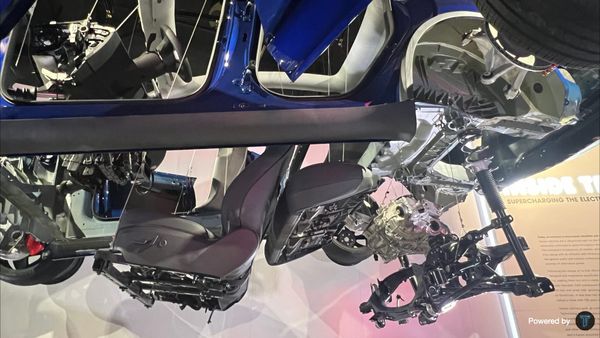
On July 20, 2026, Tesla's official account posted a cutaway of the Cybercab.
A label on the left side of the body read "Starlink Integration." The Starlink
V5 terminal SpaceX had unveiled on July 14 was going inside a driverless taxi.
Note: The author's screenshot of the Tesla post shows a timestamp of July 21,
2026 (likely KST/HKT); press coverage dates the post July 20, 2026 (likely PT).
The discrepancy reflects time zone conversion, not a factual error.
The same announcement had already happened, twelve months earlier.
At 18:53 Hong Kong time on July 22, 2025, CaoCao Inc. (2643.HK), the robotaxi arm of China's Geely group, announced a strategic partnership with Geespace, the satellite operator owned by the same group. The release headline claimed a world first: embedding low Earth orbit satellite communication services in a robotaxi platform. The stated goal was that robotaxis remain "always online, never disconnected."
Three months later, on October 16, 2025, at the World Intelligent Connected Vehicles Conference in Beijing, CaoCao declared that its robotaxi fleet had been equipped with Geespace's satellite IoT communication technology and terminal products.
That same release contains another line: CaoCao stands as the only Chinese mobility company whose full-chain capabilities are comparable to Tesla's "manufacturing plus autonomous driving plus operations" model. Geely's side raised the comparison first.
Thirty Millimeters and Three Hundred Six
Late June 2026, Hall N4 of the Shanghai New International Expo Centre. A photograph of a component sat on a Geespace slide. Three numbers ran beside it.
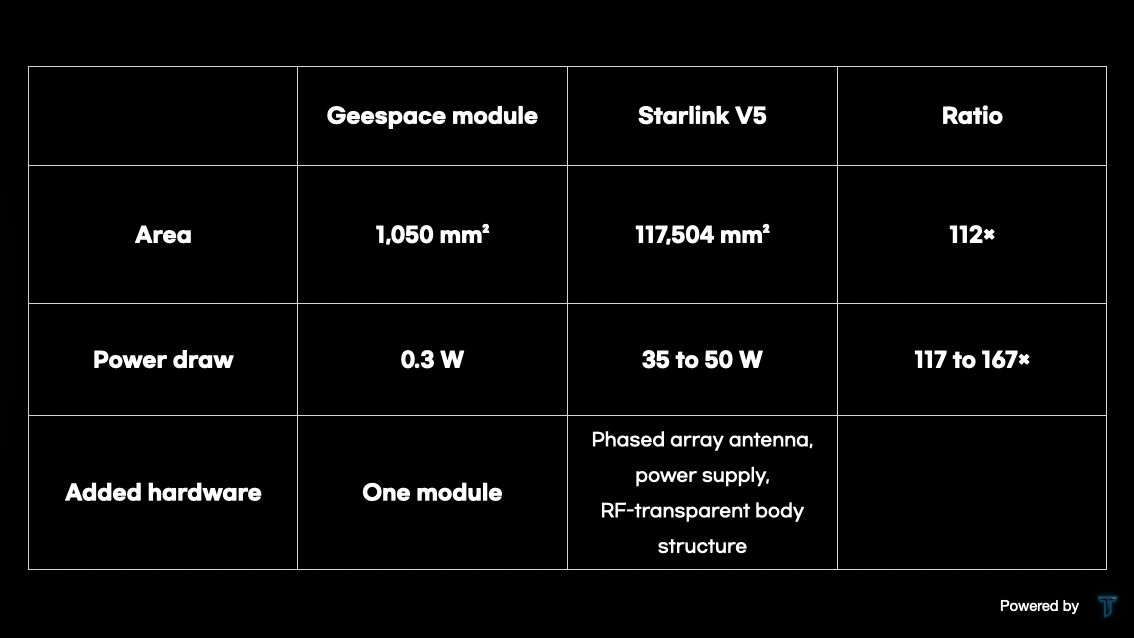
30 by 35 by 3.5 millimeters. 300 milliwatts. A 22-nanometer system on chip integrating radio frequency and baseband.
Six service categories ran down the left side of the slide. One read 汽车直连卫星: direct satellite connection for automobiles.
A month later, the official specification sheet for the Starlink V5 that Tesla said it was installing read differently.
384 by 306 by 34 millimeters. Dish weight 1.1 kilograms. Average power consumption 35 to 50 watts. Electronic phased array. Field of view 110 degrees.
What 340 Million Messages a Day Buys
The capacity sits on the constellation performance slide from the same presentation: 340 million messages per day with 64 satellites deployed.
Divide that by vehicles and the character of the system emerges.
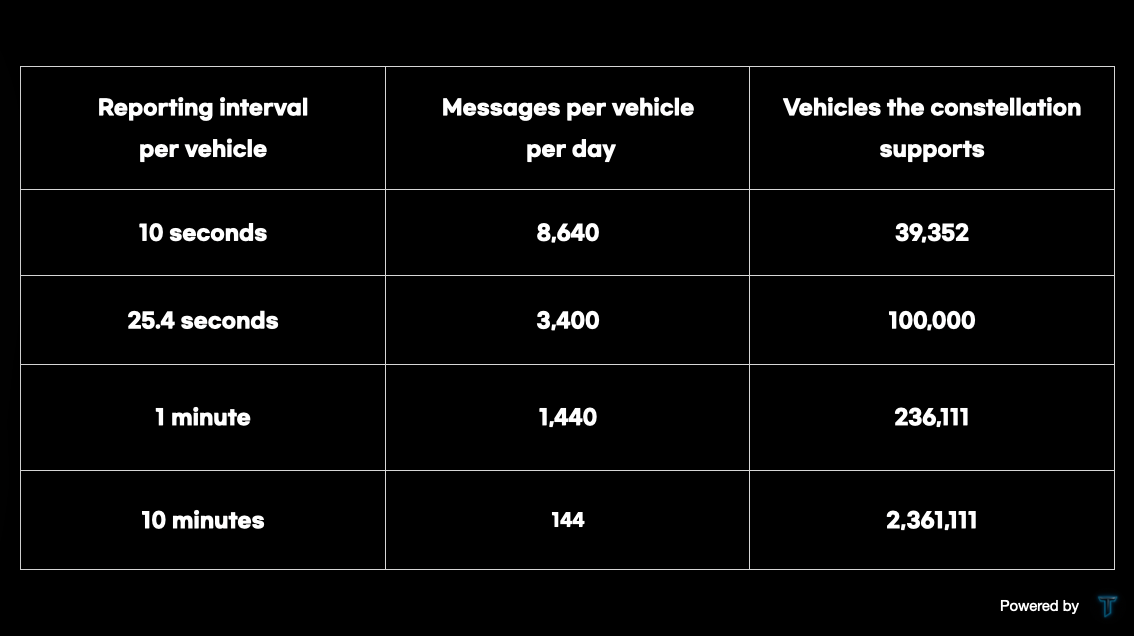
On June 18, 2026, CaoCao announced its RoboX strategy and a "Dual-100,000 Plan": 100,000 robotaxis and 100,000 robovans deployed by 2030.
Set that target against the second row. At 100,000 vehicles, each one gets a message every 25.4 seconds, and only if the entire constellation serves robotaxis alone. Nothing remains for the marine fisheries, consumer electronics, transport, energy, and agricultural monitoring customers listed on the adjacent slide.
The current scale belongs in the same frame. On May 15, 2026, CaoCao announced a partnership with Shanghai International Automobile City and a plan to deploy 100 robotaxis in Shanghai during the year. The plan requires a thousandfold increase from there.
The revisit table is more direct still.
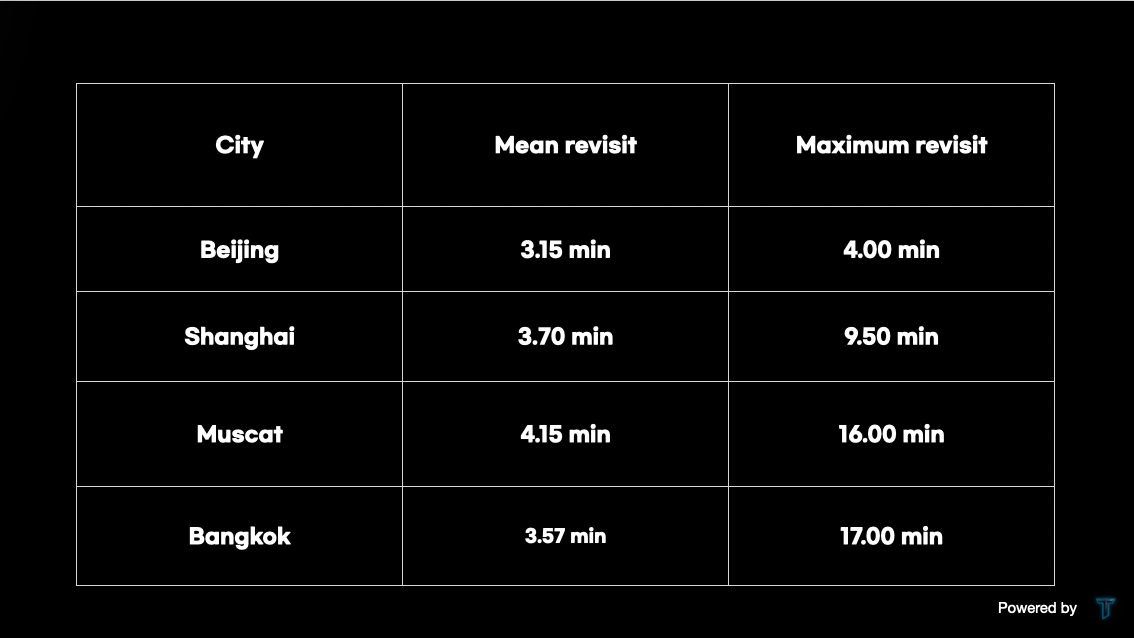
User access time is listed as 22 hours or more per day. For the remaining two hours, no satellite is visible.
The marketing line was "always online, never disconnected." The gap between that line and the spec sheet runs to seventeen minutes. What the system guarantees is closer to a bounded time to contact than to an unbroken link.
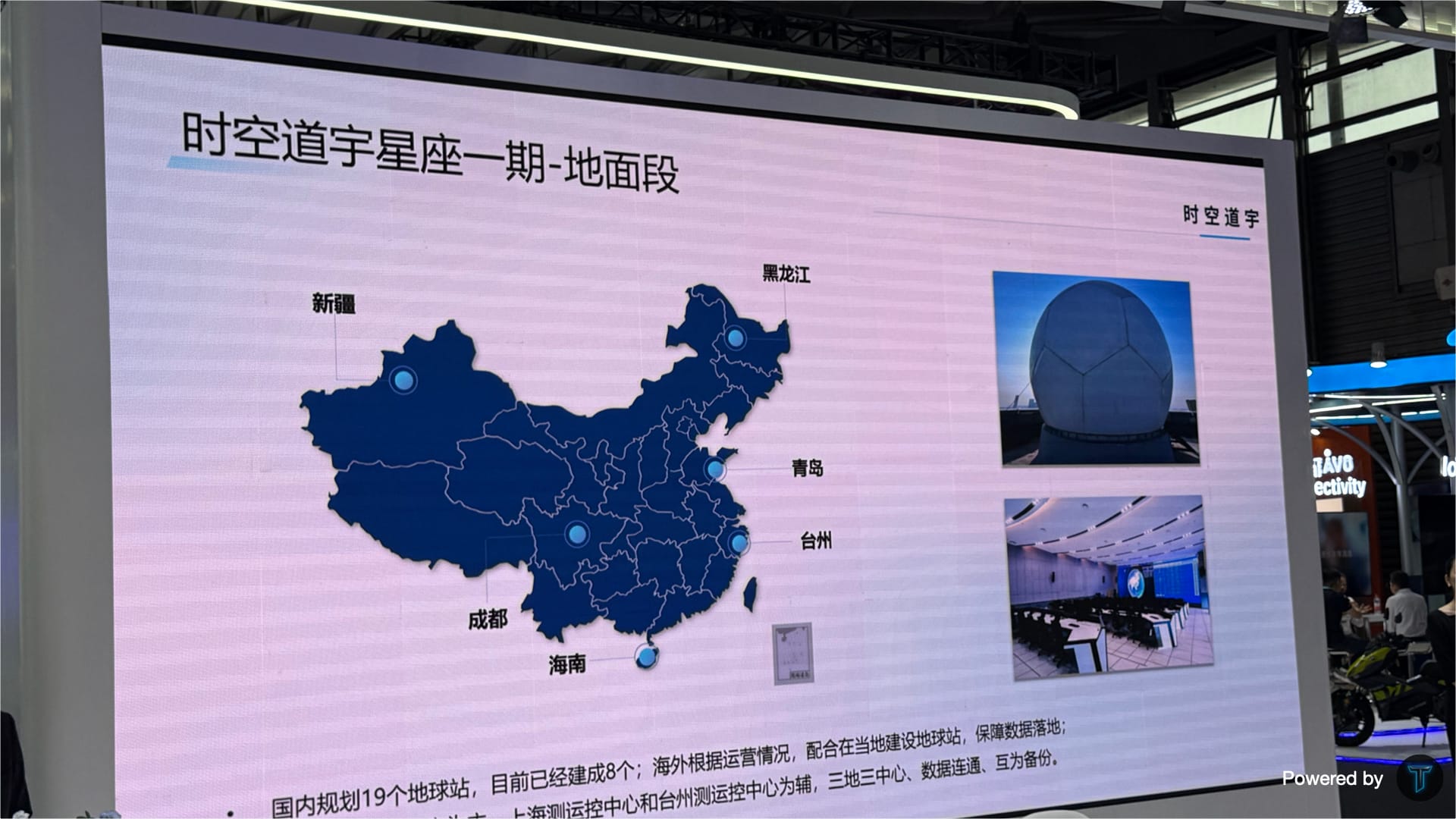
The ground segment is at a similar stage. A separate slide lists 19 domestic earth stations planned and 8 completed.
One more figure belongs here. That July 2025 release put the Geely Constellation at 30 satellites in orbit. The slide's "64 satellites deployed" is a modeling condition, and should be read separately from the in-orbit count at the time.
Which Tier Tesla's Stated Uses Fall Into
The Tesla side is empty in a symmetrical way.
Ashok Elluswamy, Tesla's vice president of AI, wrote on X the day of the announcement that connectivity is still not required for the vehicle to operate safely, and that it exists mainly for navigation, customer service, and fleet management. Two days later, on the second quarter 2026 earnings call, Musk explained that even inside Silicon Valley there are stretches with poor or no cellular coverage, and that robotaxis cannot be allowed to go missing in them.
In September 2024 the 5G Automotive Association published a technical report dividing automotive non-terrestrial network deployment into three phases by data rate: narrowband, wideband, and broadband.
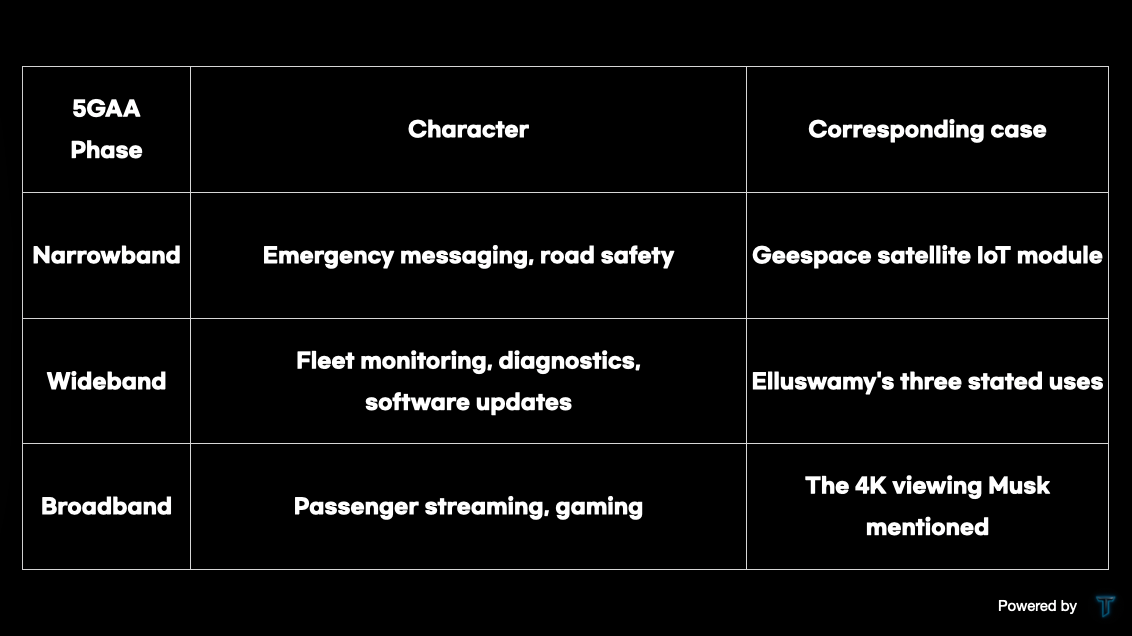
Elluswamy's stated uses land in the middle row. The Starlink V5 is built for the bottom row. 5GAA expects these phases to arrive in sequence, with initial commercial deployment in 2027.
The direction of the money is worth noting. SpaceX listed publicly in 2026 and is a separate company from Tesla. Starlink service on a Cybercab books as cost at Tesla and revenue at SpaceX. The pricing has not been disclosed and will surface only in the related party transactions note of Tesla's quarterly filing.
The roughly two billion dollars Tesla invested in xAI in January 2026 reportedly converted into SpaceX stock when SpaceX absorbed xAI. The resulting ownership percentage has not been confirmed in a filing.
Backup to the National Team
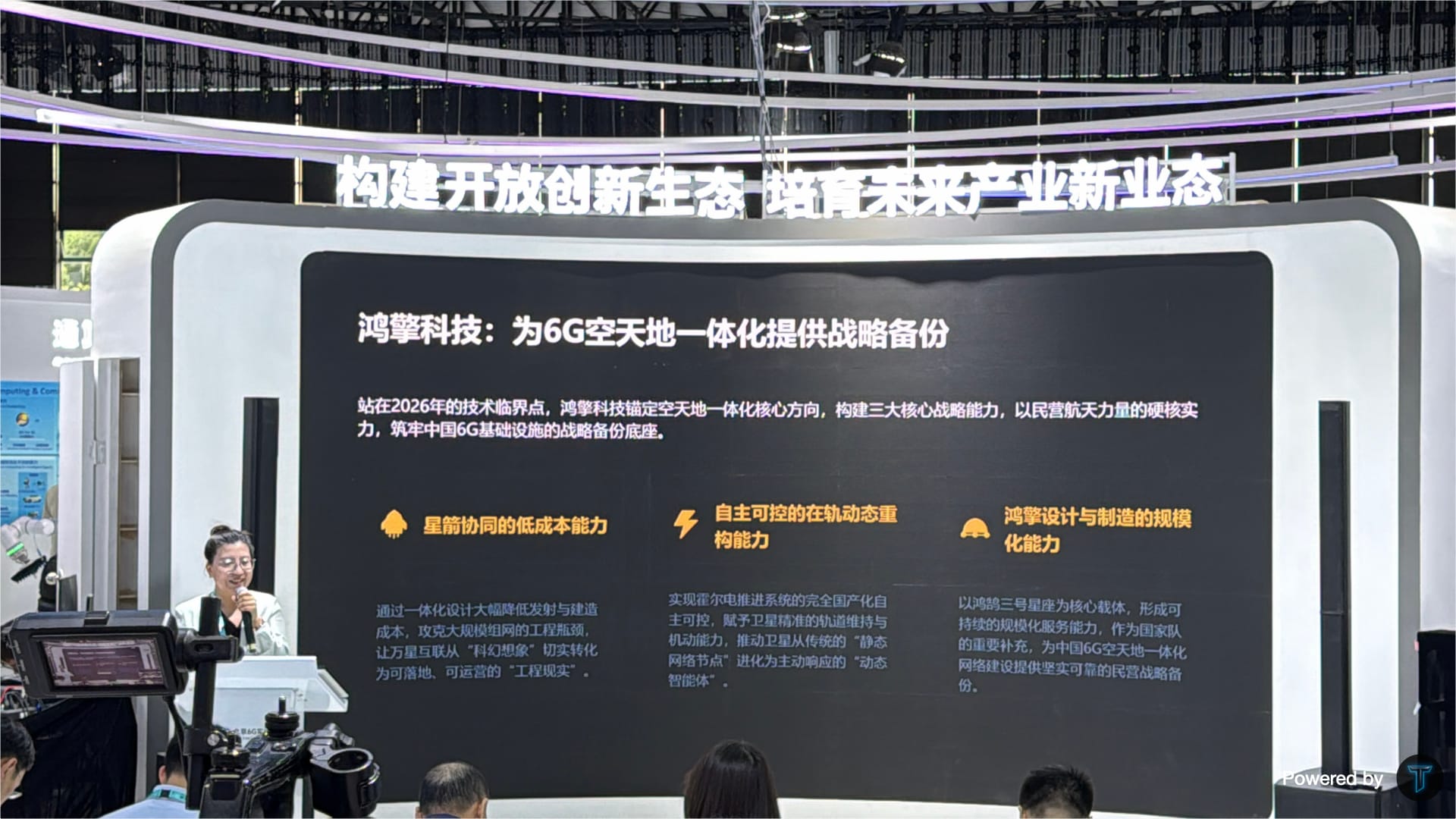
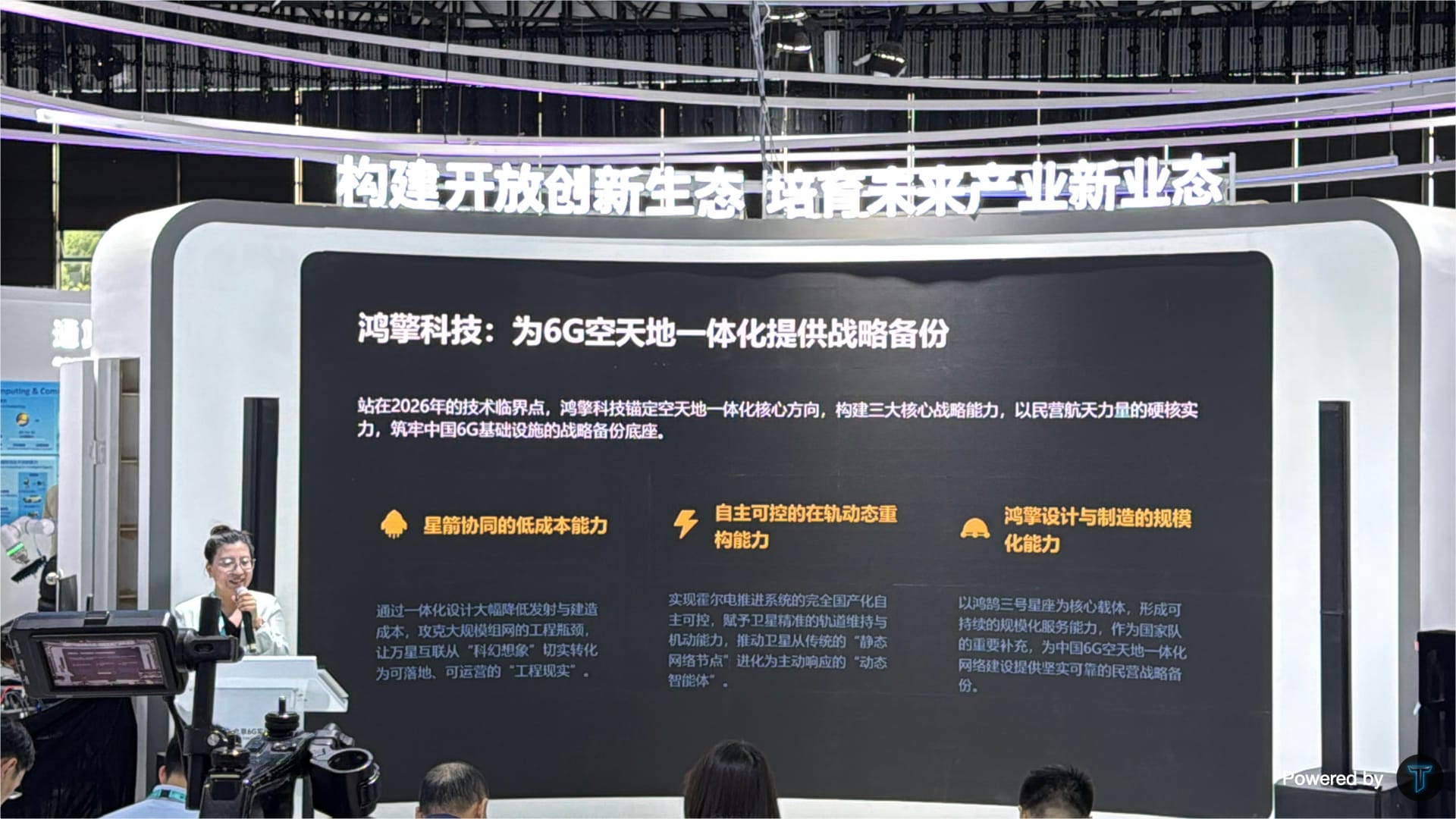
On a different stage in the same hall, a presenter from Hongqing Technology defined the company as a strategic backup foundation for China's 6G infrastructure.
Shanghai Lanjian Hongqing Technology was founded in 2017. LandSpace, developer of the reusable Zhuque-3 launch vehicle, holds 48 percent. On May 24, 2024 the company filed advance publication information with the International Telecommunication Union for the Honghu-3 constellation: 10,000 satellites across 160 orbital planes. The firm was originally known for Hall effect thruster propulsion.
That history explains the slide's second bullet, which claimed full domestic production and autonomous control of the Hall effect electric propulsion system. The third bullet positioned Honghu-3 as an important supplement to the national team, 国家队.
SpaceX does not present itself as a reserve force behind NASA. In Commercial Crew and in the Artemis lander program alike, SpaceX is a prime contractor. The self description of China's private space firms reads as a mirror of industrial structure.
The numbers show that structure. As of early July 2026 Starlink had 10,736 active satellites in orbit. Qianfan stood at 238 on July 5 and Guowang at 177 on June 17, about 415 combined.
The bottleneck is launch. Both Chinese constellations depend entirely on state owned Long March vehicles, and those vehicles also carry government and military payloads.
Guowang's December 2025 plan targeted 310 satellites launched during 2026. Actual 2026 launches through June 17 were group 18 with nine, group 19 with nine, group 20 with nine, group 21 with five, and group 22 with nine: 41 satellites. Roughly halfway through the year, that is about 13 percent of the target.
Qianfan halted launches for seven months in the second half of 2025 after satellite anomalies, and Guowang absorbed the freed slots. Qianfan has said it aims to reach 324 satellites by the end of July 2026 to complete its first phase.
That is why Honghu-3 is tied to a launch company.
477 Milliseconds
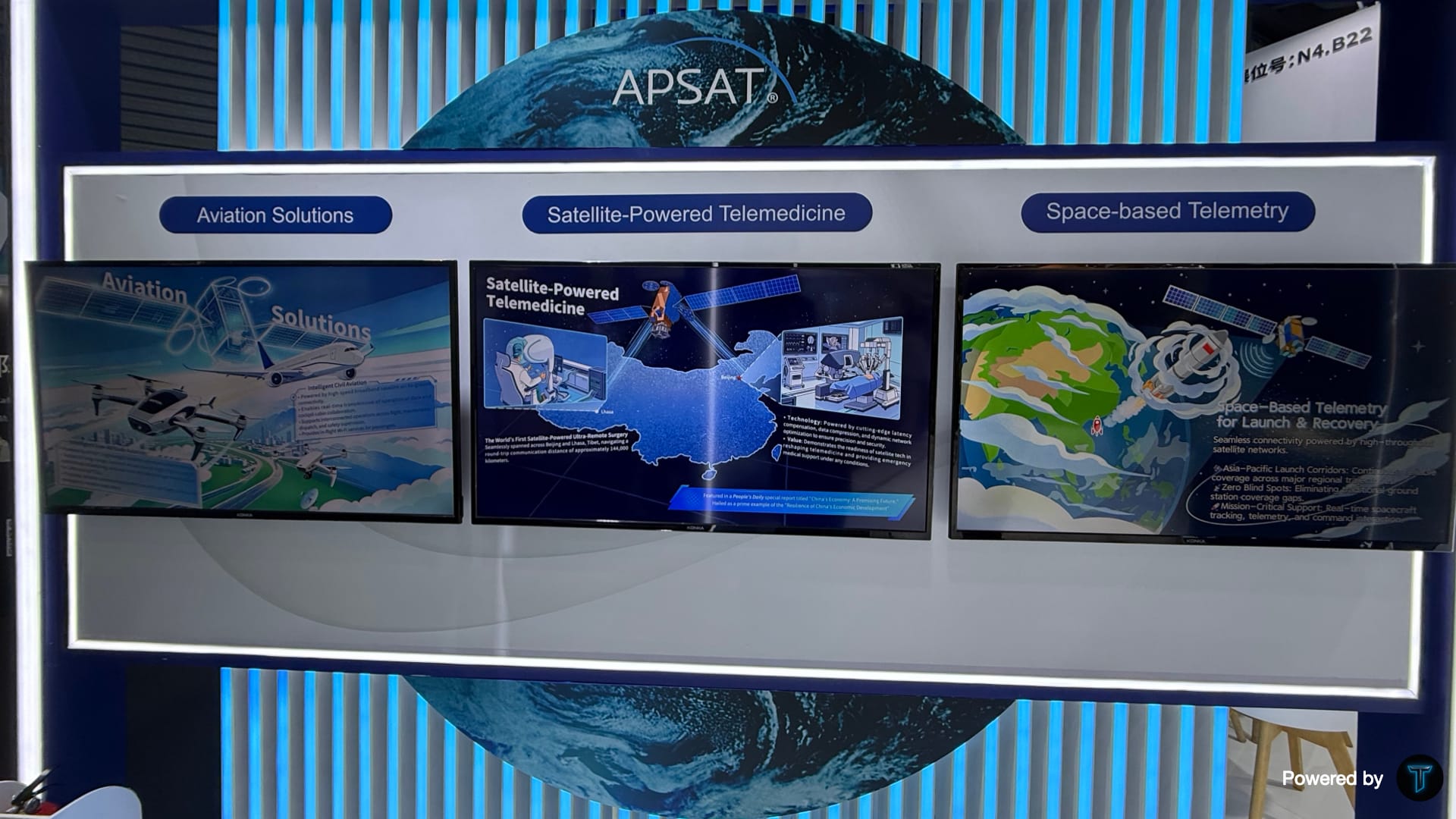
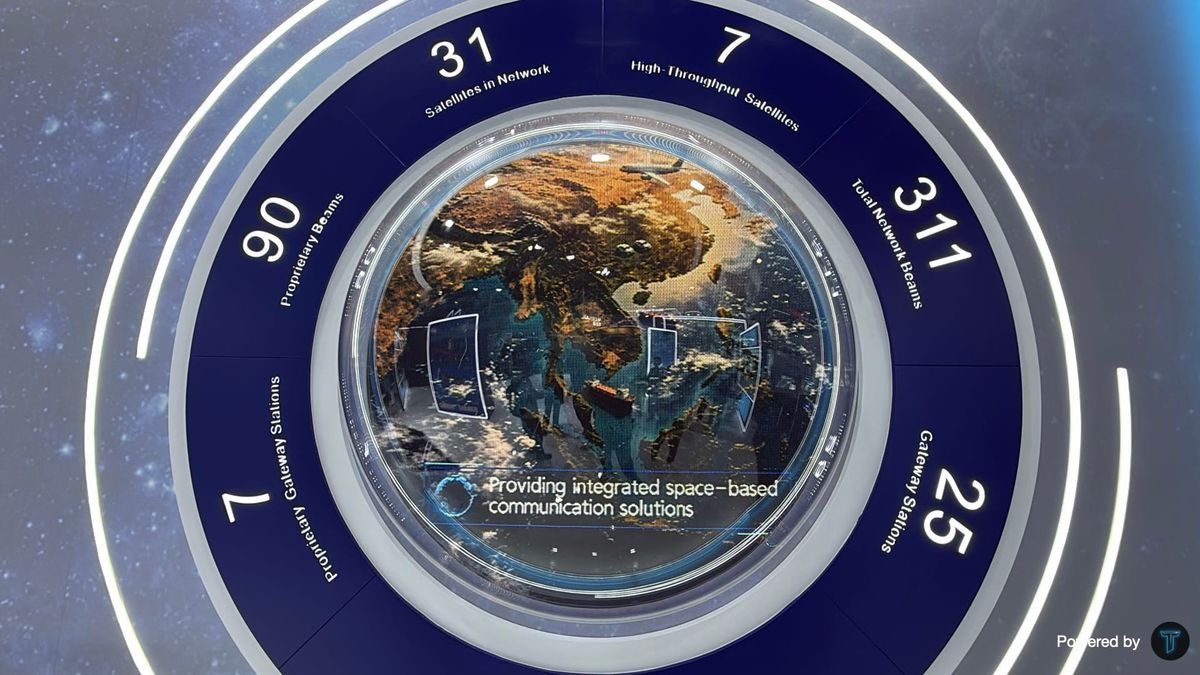
At booth N4.B22, APSAT had mounted three screens: aviation, telemedicine, and launch and recovery telemetry. The booth panel lists 31 satellites in network, 7 high throughput satellites, 311 total beams, and 25 gateway stations.
The center screen claimed the world's first ultra remote surgery, with a round trip communication distance of approximately 144,000 kilometers. That is four passes through the 35,786 kilometer geostationary altitude. Divided by the speed of light it comes to 477 milliseconds. Chinese state broadcaster CCTV put the distance closer to 150,000 kilometers, which yields 500 milliseconds.
Propagation delay is the author's calculation dividing the published distance by 299,792 kilometers per second. It excludes equipment processing delay and is therefore a floor.
In January 2025 surgeons from the Chinese PLA General Hospital operated over the APSTAR-6D satellite. Global Times reported that the team designed a new surgical plan built around high latency conditions. They did not reduce the delay. They accepted it and changed the technique.
The screen on the right matters more. Space based telemetry across launch and recovery: continuous coverage of Asia Pacific launch corridors, elimination of ground station gaps, real time spacecraft tracking and command. The function SpaceX performs by streaming live Starship video down through Starlink terminals, China is turning into a commercial service sold by a geostationary high throughput operator.
Satellite networks enter cars, operating rooms, and rocket telemetry through the same door. Robotaxis are one line on that list.
Where the Rest of the Industry Is
While Tesla and Geely each bolt on their own constellation, the other automakers walk the standards road.
In May 2025 in Paris, 5GAA staged the first demonstration of satellite connected vehicles. The participating automakers were BMW Group and Stellantis. The technology partners were Anritsu, Cubic³, Deutsche Telekom, Harman, Jember, LG Electronics, Qualcomm Technologies, Rohde & Schwarz, Rolling Wireless, Skylo, Vedecom Institute, and Viasat. The approach layers onto the existing telematics control unit and chipset without an added antenna, and the demonstrations included voice calls with seamless switching between terrestrial and satellite networks. Cubic³ used the same event to unveil an automotive grade eSIM covering both terrestrial cellular and non-terrestrial networks.
The 5GAA 2030 Roadmap puts initial market deployment of satellite connectivity in vehicles at 2027, based on IoT NTN 3GPP Release 17.
At Toyota, GM, Hyundai, and Kia, no recent public announcement on satellite connectivity could be found.
Toyota partnered with Kymeta and built a Mirai based research vehicle with satellite communications. No production announcement has followed. Its current connectivity partners are all terrestrial: NTT, AT&T, and NTT DATA's Transatel subsidiary.
GM moved its axis elsewhere. It wound down the Cruise robotaxi business in 2024 and set a 2028 target for eyes off driving in privately owned vehicles. With a driver in the car, the argument for always on fleet supervision does not arise.
Hyundai Motor Group unveiled Pleos Connect on April 30, 2026: a large language model voice agent called Gleo AI, an app market, online map navigation, and over the air updates, targeting roughly 20 million Hyundai, Kia, and Genesis vehicles by 2030. There is no satellite item in the announcement.
Given that the standards camp is aiming at 2027, none of this reads as defection.
The Seat Korea Left Empty
Korean companies are already inside the automotive satellite chain. LG Electronics appears on the participant list for the Paris 5GAA demonstration.
Domestic industrial policy is running too. In June 2026 a consortium led by SOLiD was selected to run a project under the advanced semiconductor program of the Korea Institute for Advancement of Technology, an agency under the Ministry of Trade, Industry and Energy. The project title: development of communications semiconductors and modules for cellular routers supporting low Earth orbit satellite communication. The goal is domestic production of the core semiconductors, modules, and antennas inside ground equipment for LEO satellite communications.
The participants are SOLiD, KT, Hanwha Systems, Ace Technology, Doosan Electronics, and Chungnam National University. Maeng Seung-ju, an executive vice president at SOLiD and the project lead, said the aim is a vertically integrated domestic chain running from core semiconductors through finished routers.
Hyundai and Kia are not there.
The technical base for building terminals and components is forming inside the country. Korean firms appear at the booths and on the consortium roster. Only the automaker has yet to step forward to put that base into its own cars.
Five Things to Watch
- Whether Qianfan reached 324 by the end of July 2026. It stood at 238 on July 5, leaving 86 satellites to launch in under four weeks.
- Guowang's launch rate in the second half of 2026. It managed 41 satellites in the first half against a 310 annual target.
- Zhuque-3 booster recovery. Whether a launch firm holding 48 percent of a satellite operator actually works is decided here.
- FCC equipment authorization for an automotive variant of Starlink V5. Starlink's own documentation states the retail V5 is not intended for in motion use. A new FCC ID would confirm separate hardware.
- Changes to the KEIT consortium roster. Whether a Korean automaker joins will determine where Korea stands.
For research inquiries or collaboration, contact: ceo@technorns.com
This article was researched and written by the author. Figures and statistics are drawn from official published materials, but the research and calculations were performed by a person and may contain errors. Satellite counts and fleet figures change weekly and are current as of publication. Corrections are welcome at ceo@technorns.com. AI tools were used in research and drafting. Final verification and editorial responsibility rest with the author.
Notes and Sources
- Starlink official specification sheet, Starlink V5 — https://starlink.com/public-files/specification_sheet_starlink_V5.pdf
- ACN Newswire, CaoCao and Geespace partnership (2025-07-22, 18:53 HKT) — https://en.acnnewswire.com/press-release/english/101214/satellite-direct-to-device-caocao-becomes-the-world
- Jonathan's Space Report statistics (2026-07-08) — https://planet4589.org/space/stats/active.html
- GlobeNewswire, CaoCao RoboX and Dual-100,000 Plan (2026-06-22, event June 18) — https://www.globenewswire.com/news-release/2026/06/22/3315273/0/en/caocao-announces-full-scale-ai-transformation-unveils-robox-strategy-to-build-a-globally-leading-physical-ai-mobility-technology-platform.html
- Electrek, Cybercab Starlink (2026-07-20) — https://electrek.co/2026/07/20/tesla-starlink-cybercab-integration-why/
- SpaceNews, Honghu-3 10,000 satellites, 160 planes, LandSpace 48 percent (2024-05-27) — https://spacenews.com/chinese-firm-files-plans-for-10000-satellite-constellation/
- China in Space, Guowang group 21, cumulative 168 (2026-04-09) — https://www.china-in-space.com/p/five-more-guowang-satellites-delivered
- China in Space, Guowang group 22, nine satellites (2026-06-17) — https://www.china-in-space.com/p/guowang-adds-nine-more-satellites
- China in Space, Qianfan group 14, cumulative 238 (2026-07-05) — https://www.china-in-space.com/p/largest-qianfan-group-delivered-via
- China in Space, Qianfan 324 target by end of July (2026-06-12) — https://www.china-in-space.com/p/qianfan-wants-100-new-satellites
- China in Space, Guowang 310 satellite plan for 2026 — https://www.china-in-space.com/p/chinas-mega-constellations-mega-article
- 5GAA, "Maximising the benefit of future satellite communications for automotive" technical report (2024-09) — https://5gaa.org/maximising-the-benefit-of-future-satellite-communications-for-automotive/
- 5GAA Roadmap III white paper — https://5gaa.org/content/uploads/2025/01/5gaa-roadmap-iii-wp.pdf
- 5GAA Paris demonstration press release (2025-05) — https://5gaa.org/content/uploads/2025/05/5gaa-press-release-paris-demos-web.pdf
- Participant list for the 5GAA demonstration — https://www.autonomousvehicleinternational.com/news/connectivity/5gaa-demonstrates-worlds-first-satellite-connected-vehicles.html
- GlobeNewswire, CaoCao 100 robotaxis in Shanghai (2026-05-15) — https://www.globenewswire.com/news-release/2026/05/15/3295938/0/en/CaoCao-Inc-and-Shanghai-International-Automobile-City-Forge-Strategic-Partnership-and-Plan-to-Deploy-100-Robotaxis-in-Shanghai-This-Year.html
- Electronic Times (etnews), SOLiD consortium KEIT project (2026-06-08) — https://www.etnews.com/20260608000123
- Geely official, Geespace first nine satellites (2022-06-02) — https://www.geely.com/en/news/2022/geespace-launches-nine-satellites
- Global Times, APSTAR-6D ultra remote surgery (2025-01-07) — https://www.globaltimes.cn/page/202501/1326420.shtml
- SCMP, same event (2025-01-03) — https://www.scmp.com/news/china/science/article/3293260/surgery-satellite-china-conducts-ultra-remote-medical-procedures-world-first
- CNBC, GM eyes off driving by 2028 (2025-10-22) — https://www.cnbc.com/2025/10/22/gm-tech-google-ai.html
- Hyundai Motor Group, Pleos Connect (2026-04-30) — https://www.hyundaimotorgroup.com/en/news/hyundai-motor-group-redefines-in-vehicle-experience-with-pleos-connect-next-generation-infotainment-system
- Toyota Global Newsroom, Kymeta partnership and Mirai research vehicle — https://global.toyota/en/newsroom/corporate/25249394.html
- Tesla official X, Cybercab Starlink — https://x.com/Tesla/status/2079325767260139962
- Ashok Elluswamy on X — https://x.com/aelluswamy/status/2079352975949206004
- Mobile Internet Resource Center, Starlink V5 not rated for in motion use — https://www.rvmobileinternet.com/starlink-v5-has-arrived-smaller-lighter-and-more-efficient-but-not-necessarily-faster/