Tesla's AI Chief Answered the Question I Left Open in 2024
Four of the five steps I set out in 2024 were confirmed by Tesla's head of AI. Dojo only changed its name. What changed is the question: once you abandon rules, what do you verify against?

What Ashok Elluswamy said at ScaledML 2026 overlaps almost entirely with the argument I built in my 2024 book. Four of its five steps were confirmed from his own mouth. One piece of hardware got a new name. And the question the book closed on without answering, he answered.
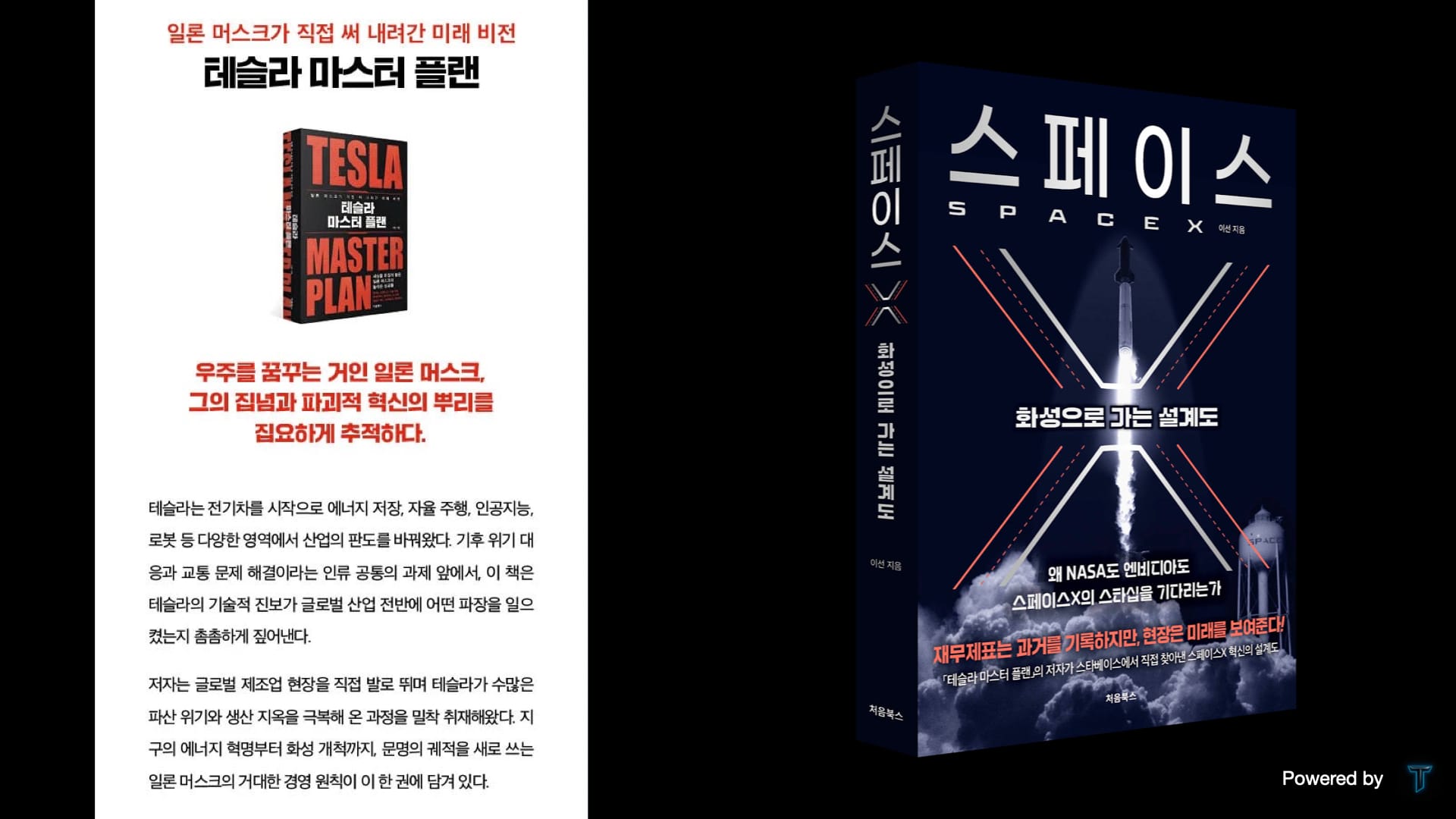
The book's axis was the Tower of Hanoi
Tesla Master Plan does not open with autonomous driving. It opens with the 1956 Dartmouth workshop. Symbolic AI, leaning on explicit knowledge representation and rule-based systems, dominated domains where the rules were clean: the Tower of Hanoi, chess, mathematical theorems. Simon and Newell's General Problem Solver worked by recursively splitting the gap between the current state and the goal state into subgoals.
The collapse point was equally clean. With three discs, GPS can enumerate the possibilities. With sixty-four, the required number of moves explodes to two to the sixty-fourth power minus one, roughly 1.84 times ten to the nineteenth. Move one disc per second and that takes about 584 billion years, roughly forty-two times the age of the universe. The premises there are 31,557,600 seconds per year and a universe age of 13.8 billion years.
So the book's proposition ran on from there. Coding every scenario individually is physically impossible, and real road conditions require managing an exponentially growing set of variables and outcomes, which makes autonomous driving the same class of problem that broke symbolic AI. Learning is required rather than rules, and learning requires data and compute.
Three years later the same argument turned up on Tesla's stage
Elluswamy said modular systems have leaky abstractions. The uncertainty carried by raw measurements is hard to communicate in full to downstream systems, and the software engineering orthodoxy of cleanly separating concerns simply does not hold up in real-world robotics.
His first example was a puddle. Crossing into the oncoming lane is bad, and avoiding puddles can be added as its own rule, but when the two collide you have a tiny trolley problem. The absence of an oncoming car does not make crossing safe either, because visibility may be compromised. You cannot decide from independent rules or logical elements. You have to consider the entire scene holistically.
The second example is blunter. After showing a clip of FSD waiting for a line of chickens to cross, including the straggler, before proceeding, he asked what an explicit perception-and-prediction architecture would do here. Build a chicken leg detector? In a second clip, a group of geese stood in the road without crossing, and the car reversed and went around them. Reading whether a bird intends to cross means reading how its legs are moving.
What my book explained through the Tower of Hanoi, he explained through a chicken leg detector. It is the same statement about where the attempt to blanket the real world in rules gives way.
The directional commitment matches too. He said the neural network approach sits on the right side of the bitter lesson, betting on scaling network size, data, training compute, and rewards rather than hand-engineered processes. My book quoted Ilya Sutskever telling Jensen Huang that researchers of that era were chasing methods like Bayesian modeling and kernel methods, theoretically elegant but with clear ceilings. The same epistemic choice, made again fourteen years apart.
The talk answered the question the book left open
The book ends on an open question. In December 2021, Musk told Lex Fridman that building an accurate vector space was extremely difficult, and gave the example of children about to cross in front of a large truck that now blocks the view. The system has to remember they were there and predict where they will be. Fridman replied that tracking an object through occlusion and re-emergence is very hard. The book asks what fundamentally drove Tesla to adopt an end-to-end strategy from FSD version 12, and closes the chapter there.
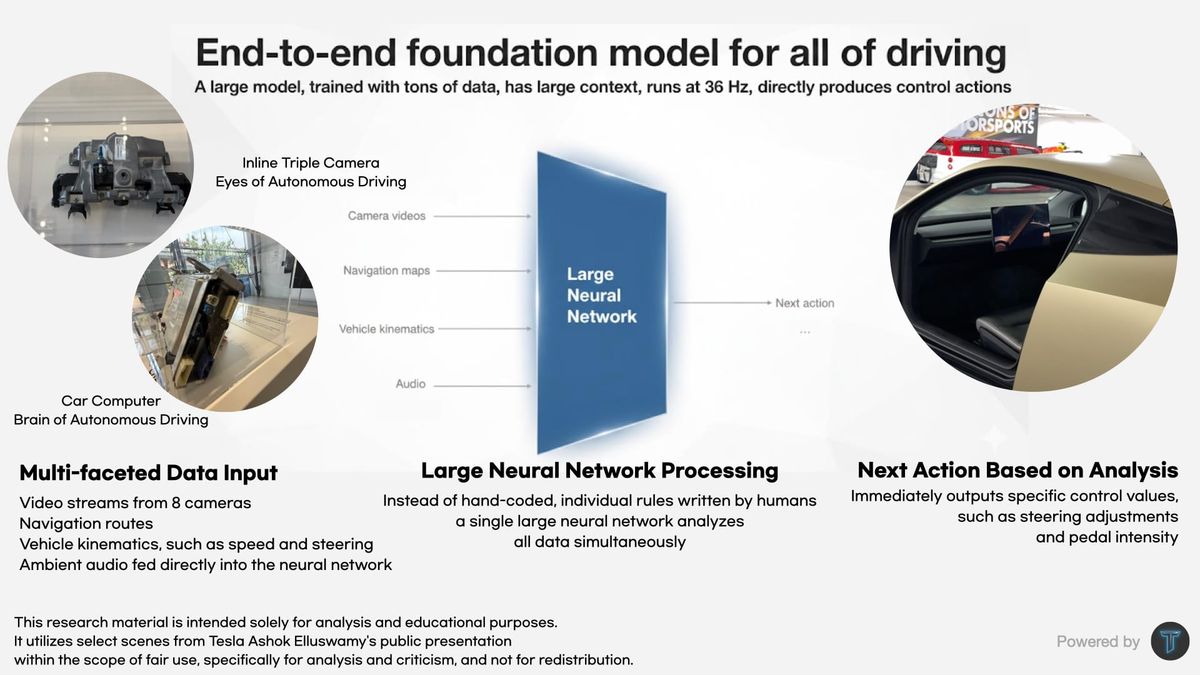
Three years later the answer arrived. Elluswamy said that stopping at a stop sign requires remembering who arrived first, which requires meaningful history. In theory you might want infinite history to solve robotics in general, but thirty seconds is workable. With eight 5-megapixel cameras running at high frame rate, thirty seconds of history amounts to roughly two billion tokens entering the network, depending on tokenization. The output is two numbers: steering angle and acceleration or braking for the next time step.
The difficulty he named is not compression but causality. Emitting two random bytes is trivial. Learning which of those two billion tokens caused those two correct actions is not. A network can just as easily learn to brake because a tree branch moved a certain way rather than because the car ahead switched on its turn signal.
The presentation slide compressed the architecture into a single line under the heading "End-to-end foundation model for all of driving." A large model, trained on enormous quantities of data, holding large context, running at 36 hertz, producing control actions directly. The inputs are drawn as four arrows: camera videos, navigation maps, vehicle kinematics, audio. Thirty-six hertz means the car is told what to do roughly every 27 milliseconds, dividing one second by 36. In the question period Elluswamy confirmed that this is the rate at which control commands are issued to the vehicle.
The memory Musk described became a thirty-second context window. The prediction became causal learning. In the talk, Elluswamy showed a vehicle ahead losing control and pointed out that the software began braking before the crash had happened, reading that the other car's yaw rate exceeded what a lane change would require and concluding several seconds early that something was wrong.
Only one piece of hardware changed its name
The book's final step was Dojo and the D1 chip, down to the specifications: nine petaflops per Dojo tile, 1.1 exaflops for a 120-tile ExaPod, and a D1 die of 645 square millimeters carrying 50 billion transistors and 362 teraflops. The logic was that reducing dependence on Nvidia required an in-house chip.
In August 2025, Bloomberg reported that Tesla had disbanded the Dojo team. Peter Bannon, who led the project, left the company, and around twenty engineers departed for a new venture called DensityAI. Musk's own account is the shortest version. He wrote on X that once it became clear all paths converged on AI6, he had to shut Dojo down and make some difficult personnel decisions, because Dojo 2 had become an evolutionary dead end. He added that Dojo 3 arguably lives on as a large number of AI6 system-on-chips mounted on a single board. On January 18, 2026, he announced that work on Dojo 3 was resuming now that the AI5 design had stabilized.
What was invalidated is the binary of Nvidia versus D1, not the proposition that enormous training compute is required. The $16.5 billion Samsung AI6 contract signed in July 2025 is evidence that the proposition still holds. The two-track structure separating training silicon from inference silicon is gone, replaced by a single family shared across vehicles, robots, and data centers.
There is one territory the book does not cover
The heaviest section of the talk is evaluation. Elluswamy broke the problem into three challenges and named evaluation the hardest, personally. Self-driving is a long-tail problem and a closed-loop system, and verifying every tail case on real roads is extremely difficult.
So Tesla trained a world simulator neural network. It learns from state-action pairs, which are easy to collect, then inverts the relation: given the current video and the current steering and pedal inputs, it generates the next video frames. Connect that generator to the policy network and the two run round-robin, simulating the world between them. The important part comes next. The two networks are trained differently, the world network can use privileged information the policy network cannot access, and that is precisely why the two can be verified independently. The examiner and the candidate have been separated.
The generation quality reaches all eight camera feeds at 5 megapixels and 36 frames per second, sustained for about a minute. Every pixel is generated. None of it is real footage. Tesla replays historical interventions to check whether a newer policy now steers correctly away from a pedestrian, and injects adversarial maneuvers that never happened into existing clips to test corner cases the fleet would rarely surface. Cut the test-time compute and the same system runs in real time, drivable like a game engine.
This territory is not in the book. It was not unforeseeable, though. Wayve unveiled GAIA-1 in June 2023, and by late September its technical report stated plainly that the model existed to accelerate the training and validation of end-to-end autonomous driving software. That was precisely when I was drafting. The accurate statement is that the book's question was why rules cannot work, and this fell outside the range of that answer.
In an earlier video script I contrasted John Deere's See and Spray, which analyzes single snapshots, with Tesla FSD, which analyzes multiple video frames. That dichotomy now needs a third term. The field has moved from reading video to generating it.
The market now, and what Korean industry should read
At the time of the talk, the Austin robotaxi service was operating publicly with nobody in the car but the passenger. CNBC reported that Musk announced the start of rides without safety monitors in Austin on January 22, 2026. The Cybercab has no steering wheel, no accelerator pedal, and no brake pedal, designed for full autonomy only, and is due later this year. In February 2026, Waymo opened public service in Dallas, Houston, San Antonio, and Orlando, extending to ten US metros.
The same video generation network generalizes to indoor scenes for Optimus to walk through, and produces action-conditioned footage down to opening a drawer. The end-to-end driving network is not a driving network. It is a foundation model for robotics, and the simulation network is trained on data common to all the robots.
This is where the road forks for Korean industry. Fleet scale and training silicon are not things you catch up on quickly. Evaluation and simulation tooling, by contrast, has no established market yet. If a substantial tier of autonomy companies cannot build their own world models, verification tooling becomes an independent market. Samsung's AI6 contract is also a reminder that a Korean company already sits at the bottom of this stack.
What remains
Four of the five steps I set out in 2024 were confirmed three years later by Tesla's head of AI. Rule-based systems collapse under combinatorial explosion. Once compute and data cross a threshold, learning wins. Autonomous driving is the same class of problem. Therefore end-to-end. The fifth step, Dojo, changed its name while the proposition survived intact.
What changed is not the answer but the question. In 2023 the question was why rules cannot work. In 2026 it is what you verify the results against once you have abandoned rules. The first question is closed. The second has only just opened, and that is where the next book goes.
For research inquiries or collaboration, contact: ceo@technorns.com