The Saturn V Was Not Giant: The Absolute Minimum Scale for the Moon
To understand SpaceX's Starship, we must look at NASA's Saturn V. Sun Lee explains how the unforgiving math of the rocket equation dictated the absolute minimum scale required to reach the moon.

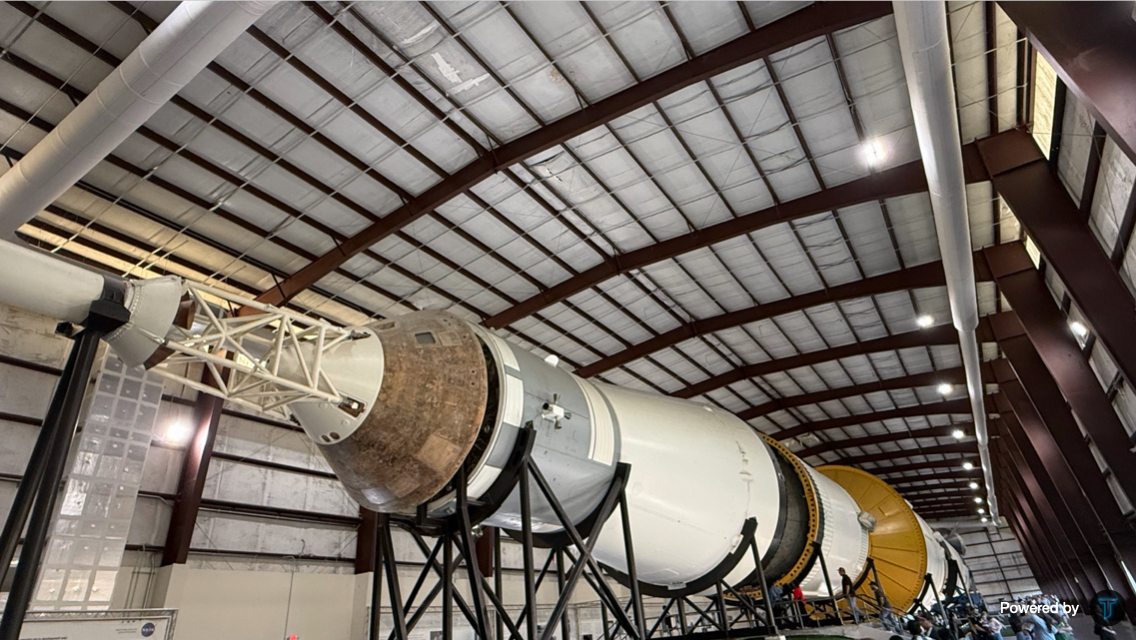
To comprehend the engineering behind SpaceX's Starship, one must first study NASA's Saturn V. When Elon Musk describes Starship, his benchmark is invariably this Apollo-era giant. "Twice the thrust of the Saturn V" is a phrase he frequently deploys. While this highlights Starship's sheer power, the comparison carries a deeper engineering truth. The Saturn V represented the absolute zenith of twentieth-century aerospace engineering; Starship treats that pinnacle merely as its starting line.
Why has the Saturn V remained the benchmark for over half a century? Why did no rocket surpass it during the intervening decades? To answer this, we must look past the spectacle and examine the underlying physics. The towering height of the Saturn V was not an exercise in national vanity. It was the precise, unyielding demand of physical law.
The Unforgiving Math of Spaceflight
When President John F. Kennedy declared in 1961 that America would land a man on the moon within the decade, he defined a massive engineering equation. The mission required launching a payload capable of escaping Earth's gravity, traveling 380,000 kilometers, landing on the lunar surface, blasting off again, and returning safely to Earth.
The solution to this problem is governed by the Tsiolkovsky rocket equation, formulated in 1903. The equation dictates that a rocket's change in velocity (delta-v) is determined by its engine's exhaust velocity and the natural logarithm of its mass ratio, which is calculated as the starting mass divided by the final dry mass.
This mathematical reality is unforgiving. To achieve a higher velocity, an engineer has only two options: increase the exhaust velocity of the engines, or increase the fuel-to-dry-mass ratio. Because chemical propellants have hard physical limits on exhaust velocity, the only practical path to the moon was to load more fuel. Yet, adding fuel increases the liftoff weight, which immediately demands even more fuel to lift that added mass. This self-amplifying loop is what forces rockets to become monstrously large.
The Mathematics of Discarding Weight
To send humans to the moon, the mission required a total delta-v of approximately 12.5 kilometers per second just to escape Earth and enter trans-lunar injection. The remaining maneuvers, including lunar orbit insertion, landing, liftoff, and return, demanded another 5 to 6 kilometers per second, which was handled by the smaller spacecraft.
At liftoff, the Saturn V weighed approximately 2.9 million kilograms. Yet, the payload sent toward the moon was a mere 48,500 kilograms. This means that 98.3 percent of the rocket's initial mass consisted of fuel and discarded structural elements. Only 1.7 percent of the original vehicle actually made it toward the destination.
This extreme disparity highlights the necessity of staging. Carrying empty, heavy fuel tanks into deep space is mathematically ruinous. To bypass this inefficiency, the rocket must shed its skin. By discarding empty stages as soon as their fuel is spent, the remaining vehicle becomes lighter, allowing the subsequent engines to push a far smaller mass. Staging was not just a design choice; it was the only mathematically viable path to the moon.
Shedding Mass to Move Forward
The Saturn V achieved this through three distinct stages, each optimized for its specific environment:
The first stage, S-IC, utilized five F-1 engines burning highly refined kerosene (RP-1) and liquid oxygen. In just 2 minutes and 42 seconds, it consumed enough propellant to push the vehicle to an altitude of 68 kilometers and a speed of 9,920 kilometers per hour. This single stage provided 85 percent of the total liftoff thrust. Once spent, its 131-ton empty structure was immediately discarded.
The second stage, S-II, then ignited its five J-2 engines. Operating outside the thickest parts of the atmosphere, it burned liquid hydrogen and liquid oxygen. Liquid hydrogen is far less dense than kerosene, but it offers a significantly higher specific impulse, meaning it yields far more thrust per unit of fuel mass in a vacuum. Over a six-minute burn, the S-II carried the vehicle to an altitude of 185 kilometers before being cast aside.
The third stage, S-IVB, powered by a single J-2 engine, performed two critical burns. The first burn placed the spacecraft into a stable low Earth orbit, where the crew spent nearly three hours performing system checks. Once cleared, the engine ignited a second time for 345 seconds, accelerating the vehicle to 39,000 kilometers per hour, which is the escape velocity required for trans-lunar injection.
Once the third stage separated, only the 48.5-ton Apollo spacecraft remained. The rest of the 2,903-ton colossus was gone.
The Minimum Scale of Ambition
The fundamental constraint of the rocket equation remains unchanged. The fuel-to-mass problem that faced NASA in 1969 is the exact same physical reality facing the Artemis missions today.
When viewed through the lens of physics, the Saturn V was not excessively large. It was, in fact, the absolute minimum physical scale required to send humans to the moon and bring them back alive. It was the smallest possible vessel that could survive the unforgiving mathematics of our universe.
For research inquiries or collaboration, contact: ceo@technorns.com